

Does Your GRESB Score Count Towards AASB S2 Compliance?

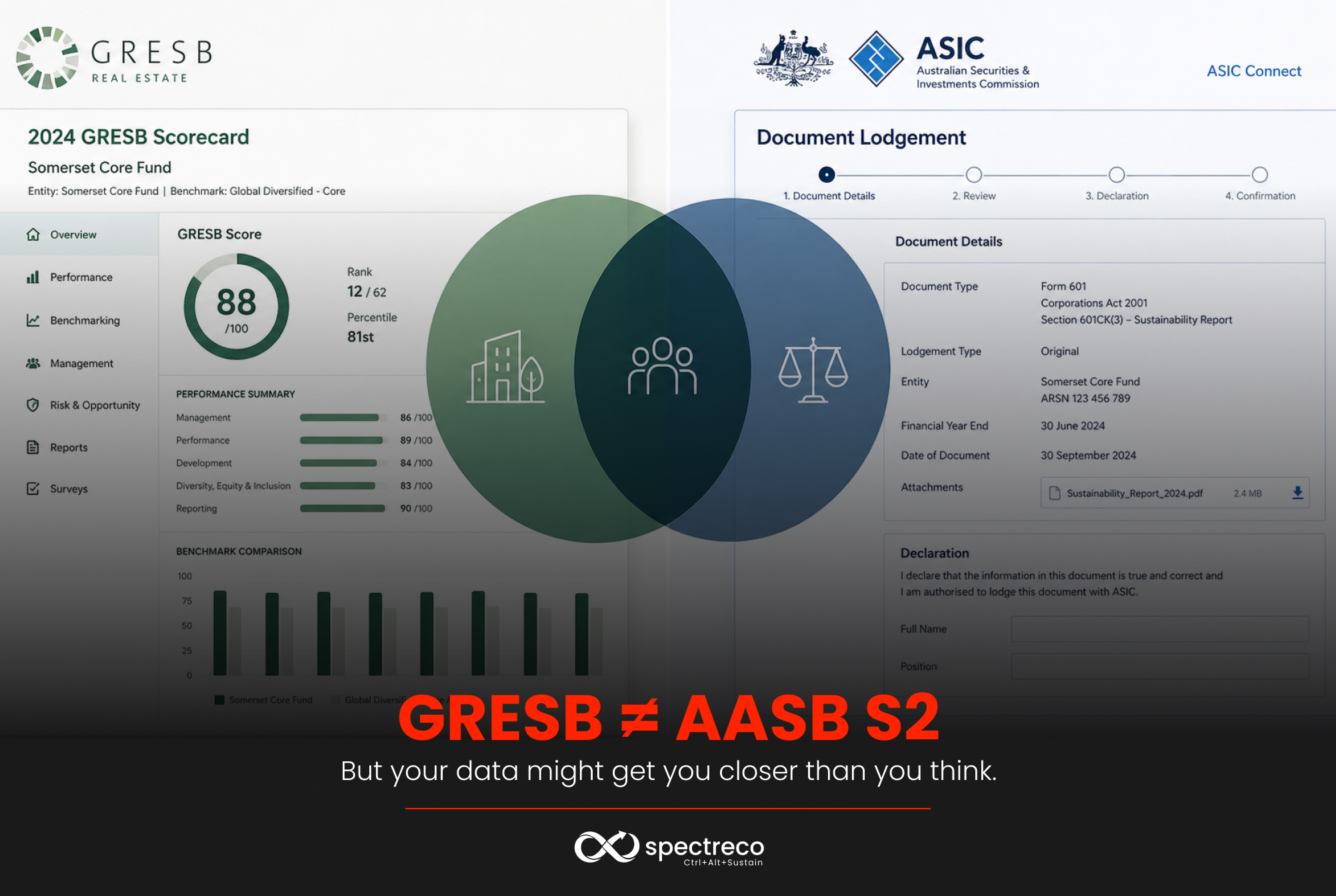
Most Australian REITs and property funds completing their GRESB assessment this year are asking the same question: if we already collect this data for GRESB, how much of it can we use for AASB S2?
The short answer is no. Your GRESB score does not count as AASB S2 compliance. GRESB (Global Real Estate Sustainability Benchmark) is a voluntary investor benchmark. AASB S2 (Australian Sustainability Reporting Standard S2: Climate-related Disclosures) is a mandatory legal obligation embedded in the Corporations Act 2001, with auditor sign-off, ASIC enforcement, and civil penalties of up to about A$1.82 million per contravention for individuals.
The longer answer is more useful. Your GRESB data, if it was collected properly, maps directly onto several AASB S2 disclosure requirements. The overlap is real, intentional, and significant. But the gap between what GRESB requires and what AASB S2 demands is exactly where Australian property firms are most likely to get caught.
This article explains what transfers, what does not, and what Group 2 property companies need to do before July 2026.
Why Australian Property Firms Keep Confusing GRESB with AASB S2
The confusion is understandable. Both frameworks use the same four-pillar structure: governance, strategy, risk management, and metrics and targets. Both require GHG emissions data. Both cover scenario analysis and climate risk identification.
The reason they look so similar is not a coincidence. AASB S2 is based on IFRS S2, and IFRS S2's industry-based metrics for real estate were directly modelled on the GRESB Real Estate Assessment. GRESB is cited by name in the IFRS guidance document definitions, calculations, and specific terms are drawn directly from GRESB methodology. The GRESB Real Estate Assessment forms the basis upon which IFRS S2's real estate industry metrics were structured.
The critical difference: GRESB is scored and validated by GRESB. AASB S2 is audited by your financial statement auditor and lodged with the Australian Securities and Investments Commission (ASIC). One generates a benchmark report for investors. The other generates a legal document that directors are personally liable for.
GRESB was the foundation. AASB S2 is the legal structure built on top of it. Participation in one does not satisfy the other.
What Your GRESB Data Can Directly Support in AASB S2
Three areas of genuine, usable overlap where existing GRESB data can directly feed AASB S2 disclosures:
Metrics and Targets
- Scope 1 and Scope 2 emissions collected at asset level for GRESB align directly with AASB S2's Year 1 mandatory metrics disclosure.
- Energy intensity and emissions intensity figures from GRESB's Performance Component feed AASB S2's quantitative disclosure requirements for the real estate sector.
- NABERS ratings and energy consumption data collected for GRESB building-level performance indicators support AASB S2's industry-specific metrics.
Governance
- Board ESG oversight indicators from GRESB committee accountability, executive performance targets tied to sustainability objectives, map onto AASB S2's governance disclosure requirements.
Risk Management
- Climate resilience indicators covering transition and physical risk identification in GRESB align with the framing of AASB S2's risk management pillar.
Summary table:
| AASB S2 Pillar | What GRESB Already Covers | What Still Needs Doing |
|---|---|---|
| Metrics & Targets | Scope 1 & 2 emissions data, energy intensity, asset-level GHG figures | Audit trail to source data; market-based Scope 2 methodology documentation |
| Governance | Board ESG oversight indicators, committee accountability, exec ESG targets | Narrative disclosure of board processes, review frequency, expertise specifics |
| Risk Management | Climate resilience indicators, transition and physical risk identification | Financial impact quantification; integration with enterprise risk register |
| Strategy | Scenario analysis indicators (whether performed) | Actual scenario outputs, financial impact modelling, documented methodology |
Where GRESB Stops and AASB S2 Begins
Three gaps that catch Australian property firms off guard, the places where GRESB participation creates a false sense of readiness:
Gap 1: Audit trail vs. benchmark submission
GRESB submissions are validated by GRESB. AASB S2 data must survive limited assurance review by your financial statement auditor, the same firm that signs off on your accounts.
That means every Scope 1 and Scope 2 figure needs a traceable path back to source metering or utility invoices, with documented calculation methodology and recorded assumptions.
A GRESB submission that used estimates or extrapolated data for some assets will not pass AASB S2 limited assurance review in its current form.
Gap 2: Scope 3 emissions
GRESB captures some Scope 3 data, tenant energy use for Performance Component, embodied carbon for development assets. But this is not collected with the category-level granularity or methodology rigour that AASB S2 requires from Year 2 onwards.
Tenant energy data from GRESB is a starting point for Scope 3 Category 13 (downstream leased assets). It is not a compliant Scope 3 disclosure on its own.
Gap 3: Financial quantification
AASB S2 requires entities to quantify the financial impact of climate-related risks and opportunities on cash flows, cost of capital, and access to finance.
GRESB does not require this. A property portfolio can score well on GRESB's climate risk indicators without having a single line of financial impact analysis documented.
This is what early reviews of Group 1 reports are already flagging. PwC's early review of 22 December 2025 year-end Group 1 disclosures found that one-third of companies did not quantify the financial impact of climate risks, relying instead on proportionality mechanisms and citing measurement uncertainty. Auditors and ASIC have signaled this will attract scrutiny as assurance requirements increase.
Source: PwC Australia, AASB S2 Unpacked: How Did Australia's Group 1 Climate Reporting Fare?, March 2026.

How to Use Your GRESB Submission to Accelerate AASB S2 Preparation
Four steps, in order. This is the practical sequence for a Group 2 property company with an existing GRESB program and a July 2026 AASB S2 start date.
- Map your GRESB data against AASB S2 pillar by pillar. Use the table above as the starting point. Identify which GRESB indicators feed which AASB S2 disclosure requirement, and where the methodology gap exists.
- Audit-proof your emissions data. For Scope 1 and Scope 2 data already collected via GRESB, trace each figure back to source metering or utility invoices. Where estimates or extrapolations were used, document the methodology now. This is what your auditor will ask for first.
- Start your Scope 3 gap assessment. Use the tenant energy data from your GRESB Performance Component as the baseline for Scope 3 Category 13 (downstream leased assets). Identify which assets have sub-metering and where bundled lease agreements are blocking data access.
- Separate your GRESB and AASB S2 workflows. They have different timelines, different evidence standards, and different audiences. Running them as a single process creates audit risk. Run them in parallel — shared data inputs, separate documentation, separate sign-off.
Frequently Asked Questions (FAQs)
Does completing a GRESB assessment mean I comply with AASB S2?
No. GRESB is a voluntary investor benchmark. AASB S2 is a mandatory statutory obligation under the Corporations Act 2001, requiring audited disclosures lodged with ASIC. GRESB data — if audit-ready — can support several AASB S2 pillars, but GRESB participation does not satisfy the legal obligation.
Which GRESB metrics map onto AASB S2 disclosures?
Scope 1 and Scope 2 GHG emissions, asset-level energy intensity, and governance indicators from GRESB align most directly with AASB S2's metrics and governance pillars. Scenario analysis indicators partially support the risk management pillar, but AASB S2 requires financial impact quantification that GRESB does not collect.
What is GRESB?
GRESB (Global Real Estate Sustainability Benchmark) is the annual ESG assessment and benchmarking framework for listed property companies, private funds, developers, and institutional investors. It scores real estate portfolios on management quality and asset-level ESG performance. It is widely used by Australian REITs and property funds to report sustainability performance to institutional investors.
Does GRESB data need to be audit-ready for AASB S2?
Yes. AASB S2 requires limited assurance on Scope 1 and Scope 2 emissions from Year 1, conducted by the same auditor as your financial statements. GRESB submissions are validated but not audited to financial reporting standards. Any GRESB data used in AASB S2 disclosures must be traceable to source systems with documented methodologies and recorded assumptions.
When does AASB S2 apply to Australian REITs and property funds?
Group 2 entities, including most mid-market property funds and REITs meeting at least two of: consolidated revenue of A$200M or more, assets of A$500M or more, or 250 or more employees, must report for financial years beginning on or after 1 July 2026. Asset owners managing A$5 billion or more in assets are also captured from Group 2 onwards.
The July 2026 window is shorter than it looks. GRESB's submission deadline is 1 July. For Group 2 property companies with a 30 June year-end, AASB S2 reporting begins the same month. Running both simultaneously without a clear mapping between the two is where audit exposure builds up.
The good news: if your GRESB programme is mature, you are not starting from scratch on AASB S2. The data architecture is largely in place. What is missing is the audit trail, the financial quantification, and the workflow separation.
Spectreco works with Australian property companies to map existing GRESB data against AASB S2 requirements, close the methodology gaps, and produce audit-ready disclosures without duplicating effort. Book a 30-minute GRESB-to-AASB S2 data mapping session with our team.
Book a GRESB-to-AASB S2 mapping session → spectreco.com


More From Our Blog


Your ESG Journey?