

SECP Phase 2 (1 July 2026): IFRS S2 Readiness Guide

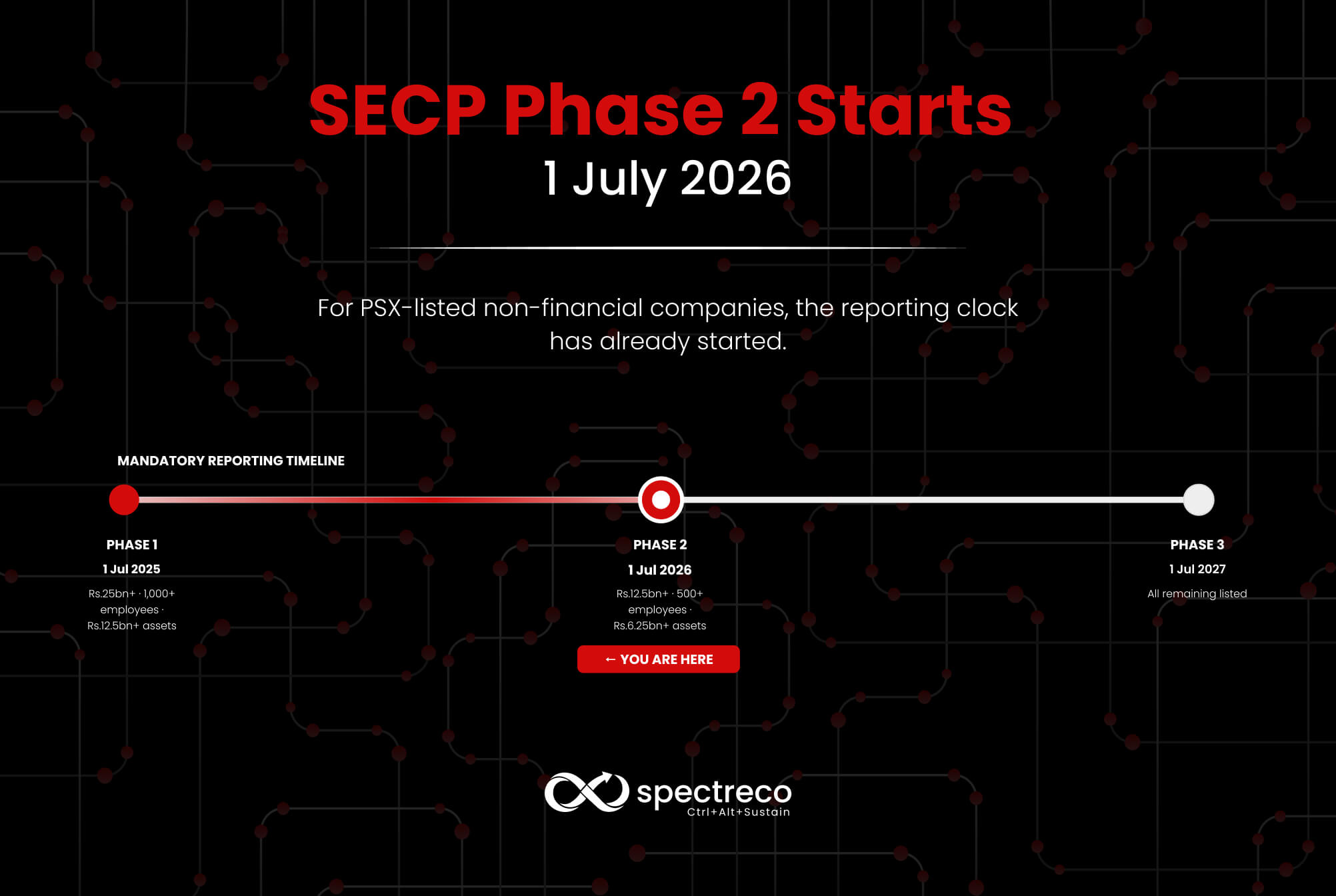
SECP Phase 2 Starts 1 July 2026: The Complete Readiness Guide for Pakistan Non-Financial Companies
If your company is listed on the Pakistan Stock Exchange (PSX) and crossed two of three size thresholds in its last financial year, your first mandatory climate report is no longer a future problem.
The Securities and Exchange Commission of Pakistan (SECP) set Phase 2 of its IFRS S1 and IFRS S2 mandate to begin for annual reporting periods starting on or after 1 July 2026. For the large group of non-financial companies with a June financial year-end, that reporting clock starts now.
Spectreco, an ESG technology and advisory firm with offices in Atlanta, London, Lisbon, and Lahore, builds the integrated platform and Virtual Sustainability Office that Pakistani companies use to meet this mandate. This guide sets out who Phase 2 catches, what you must disclose, and a 30-day plan to be ready.
What Is SECP Phase 2 for IFRS S2?
SECP Phase 2 is the second cohort of Pakistan’s mandatory sustainability reporting regime. From annual reporting periods beginning on or after 1 July 2026, listed companies that meet any two of three size thresholds must disclose climate and sustainability information under IFRS S1 and IFRS S2, alongside their audited financial statements.
The SECP issued the order on 31 December 2024 under section 238 of the Companies Act, 2017, phasing the standards across three reporting cohorts. IFRS S1 (General Requirements for Disclosure of Sustainability-related Financial Information) sets how you report. IFRS S2 (Climate-related Disclosures) sets what you report on climate. Both were issued by the International Sustainability Standards Board (ISSB) in June 2023.
Source: IFRS Foundation, Jurisdictional Profile: Pakistan (IFRS Foundation jurisdictional profile, updated June 2025)
Which Companies Fall Into SECP Phase 2?
Phase 2 captures PSX-listed companies that meet any two of three thresholds: annual turnover above Rs. 12.5 billion in the last two consecutive financial years, more than 500 employees at year-end, or total assets above Rs. 6.25 billion. Non-financial companies in textile, cement, FMCG, and real estate are squarely in scope.
The two-of-three threshold test
You are in Phase 2 if your listed company meets at least two of the following:
- Annual turnover above Rs. 12.5 billion in the last two consecutive financial years.
- More than 500 employees at the last financial year-end.
- Total assets above Rs. 6.25 billion at the last financial year-end.
The phased timeline tells you where you sit, and when reporting becomes mandatory:
Source: IFRS Foundation, Jurisdictional Profile: Pakistan (IFRS Foundation jurisdictional profile, updated June 2025)
One nuance matters for planning. The 1 July 2026 trigger is the start of your first in-scope reporting period, not a filing deadline. A company with a June year-end first reports for FY2026-27. First-year transition relief allows the sustainability disclosures to be published separately within nine months of the financial year close.
Source: Associated Press of Pakistan, SECP notifies adoption of IFRS Sustainability Disclosure Standards (SECP notification, January 2025)
Why non-financial companies cannot wait
Pakistan’s climate exposure is both physical and transition-driven. Floods, heat stress on agriculture, and water risk hit textile and food supply chains directly, while decarbonisation pressure squeezes cement, fertiliser, and energy-intensive manufacturing.
Export buyers compound the timeline. European and global customers now ask Pakistani suppliers for Scope 1 and Scope 2 emissions data as a condition of doing business. For a textile or surgical-goods exporter, the climate report is becoming a commercial document long before the regulator audits it.
Source: The News International, Can Pakistan’s firms keep up with global ESG rules? (The News, October 2025)
What Phase 2 Companies Must Disclose Under IFRS S1 and IFRS S2
Phase 2 requires disclosures under both standards, located in the annual report after the directors’ report and published at the same time as the financial statements. Independent assurance from the company’s auditor begins in the second year of reporting, so the data you publish in year one must already be defensible.
Source: IFRS Foundation, Jurisdictional Profile: Pakistan (IFRS Foundation jurisdictional profile, updated June 2025)
The four IFRS S2 pillars for a non-financial business
IFRS S2 follows the four-pillar structure inherited from the Task Force on Climate-related Financial Disclosures (TCFD):
- Governance: which board committee owns climate oversight, how often it reviews climate risk, and what expertise informs those reviews. For most Pakistani boards this means a formal resolution and an updated committee charter.
- Strategy: how climate risks and opportunities affect your business model and financial planning, supported by scenario analysis across different warming pathways.
- Risk management: how climate risk is identified, assessed, and managed, integrated into your existing enterprise risk process rather than bolted on.
- Metrics and targets: Scope 1 (direct emissions from owned or controlled sources), Scope 2 (purchased electricity, heat, steam, or cooling), and material Scope 3 (value-chain) emissions, plus targets and industry-based metrics.
Source: IFRS Foundation, Introduction to the ISSB and IFRS Sustainability Disclosure Standards (IFRS Foundation, June 2023)
For a cement producer or textile exporter, the metrics pillar is the heavy lift. Building an auditable Scope 1 and Scope 2 inventory from utility bills, fuel records, and production logs is where most first-time reporters lose months. Spreadsheet-based tracking rarely survives the year-two assurance review, a pattern we cover in our breakdown of the reporting mistakes companies keep making.
Your 30-Day SECP Phase 2 Readiness Checklist
Five steps move a non-financial company from “not started” to audit-ready foundations inside a month.
- Confirm scope and reporting date (Days 1–3). Test the two-of-three thresholds against your last two financial years. Confirm whether your first in-scope period is FY2026-27 for a June year-end, or the period beginning on or after 1 July 2026 for other year-ends.
- Stand up governance (Days 4–10). Assign climate oversight to a named board committee, update its charter, and brief directors. Pass the resolution before any report is drafted.
- Run a gap analysis (Days 11–18). Map your current disclosures against the four IFRS S1 and IFRS S2 pillars. Identify missing data points, assign owners, and flag the systems you lack.
- Build the Scope 1 and 2 baseline (Days 19–26). Collect 12 months of utility, fuel, and production data and select your measurement methodology under the GHG Protocol. This is the dataset your auditor will test in year two.
- Choose reporting infrastructure (Days 27–30). Decide between spreadsheets, a managed advisory service, or a purpose-built ESG platform. For a first audited report with Scope 3 obligations arriving next, the spreadsheet route compounds audit risk every year.
Spectreco’s Compliance, Reporting and Disclosures advisory runs this exact sequence with Pakistani clients, pairing the gap analysis with an AI-validated data layer so the numbers hold up under assurance.
SECP Phase 2 FAQ
Get Phase 2 Ready Before Your Year-End Closes
If your June year-end falls inside Phase 2, the runway is measured in weeks, not quarters. Book a Spectreco Phase 2 fast-track assessment: we confirm your scope, run the four-pillar gap analysis, and stand up an audit-ready Scope 1 and 2 baseline on our ESG platform and Virtual Sustainability Office. Start with our Pakistan and GCC ESG Intelligence coverage, then talk to the team that built Pakistan’s first integrated SECP compliance platform.
Working across the region as well? Our GCC compliance guide on the 2026 deadlines and the July 2026 IFRS S2 readiness playbook map the same four pillars across jurisdictions.
.jpg)
.jpg)
More From Our Blog

Your ESG Journey?