

The 2026 Sustainable Debt Market: Why Green Bonds Are Booming and SLBs Are Shrinking

Sustainable Debt Is Growing Again in 2026, But Only Where Investors Can Verify the Claim
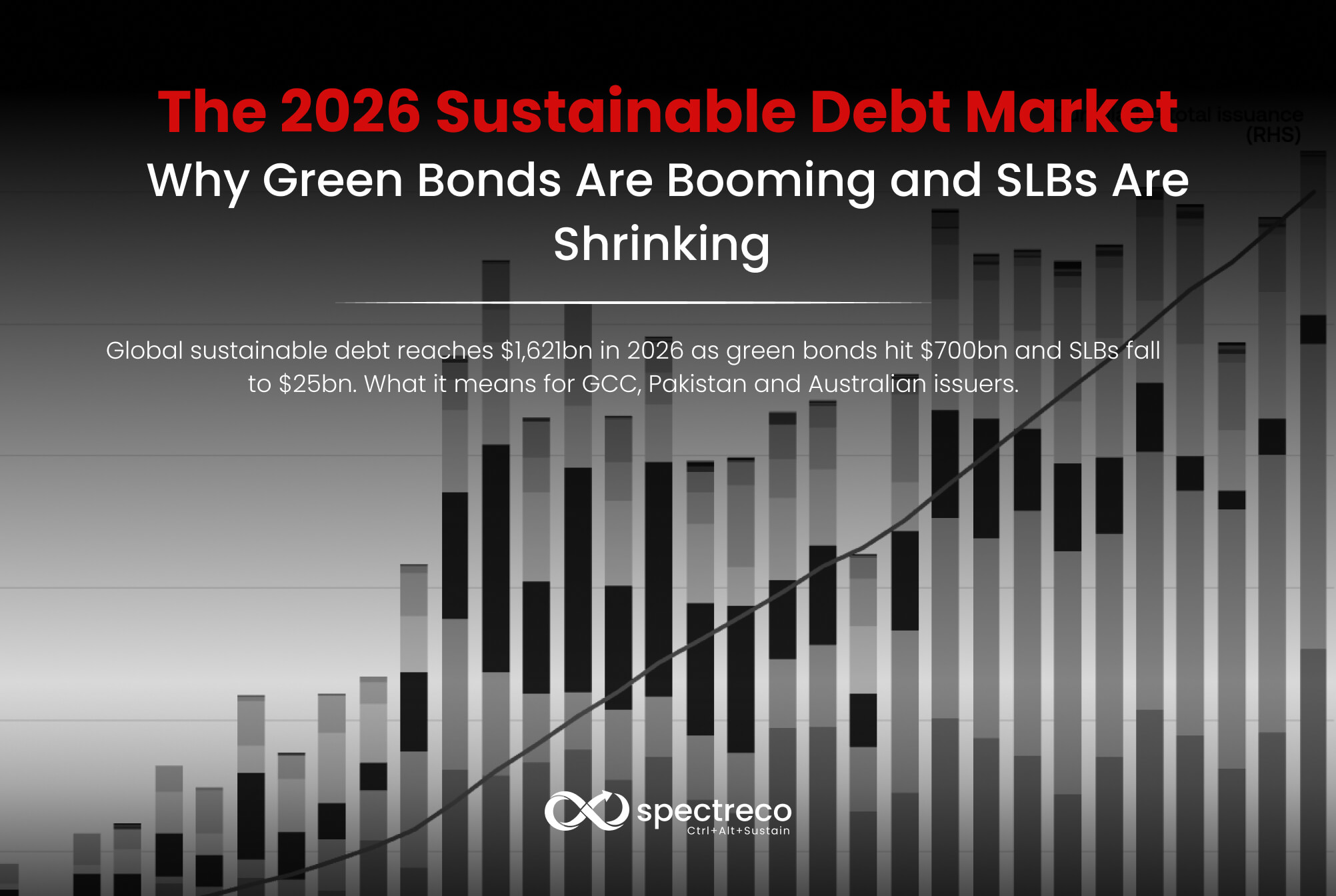
Global sustainable debt issuance is set to grow again in 2026, but the money is moving toward the instruments investors can actually verify. ING forecasts total global sustainable finance issuance, excluding asset-backed securities, of US$1,621bn in 2026, up from US$1,539bn in 2025. Green bonds alone are projected at roughly US$700bn. Sustainability-linked bonds, the instrument that was supposed to reward companies for hitting climate targets, are forecast to collapse to around US$25bn on credibility concerns.
Spectreco, an ESG technology and advisory firm with offices in Atlanta, London, Lisbon, Dubai, Muscat and Lahore, reads that split as the defining story of the 2026 market. Capital is not leaving sustainable debt. It is consolidating into structures with a clear, provable use of proceeds and abandoning structures where the sustainability claim is soft. For any issuer in the GCC, Pakistan or Australia weighing a green bond against a sustainability-linked bond in 2026, that shift changes the answer.
Source: ING Think, Sustainable Debt Outlook 2026
In this article
- How big the sustainable debt market will be in 2026
- What is driving green bond growth
- Why sustainability-linked bonds are shrinking
- How regional issuance is trending across APAC and EMEA
- What the outlook means for GCC green sukuk issuers
- What it means for Pakistani and Australian corporates
- How to choose between a green bond and an SLB
- FAQ
How Big Will the Sustainable Debt Market Be in 2026?
The sustainable debt market will reach roughly US$1,621bn in 2026 on ING’s forecast, a recovery from US$1,539bn in 2025. That is growth, but it sits below the 2024 total of US$1,668bn and well below the 2021 record. The market is expanding again without returning to its peak.
The recovery is uneven across instruments, and that unevenness is the real signal. Green bonds, debt whose proceeds are ring-fenced for environmental projects, lead the market at around US$700bn. Green loans add roughly US$255bn. Sustainability bonds, which fund a mix of environmental and social projects, are forecast at about US$290bn, up from US$271bn.
Sustainability-linked loans (SLLs), where the interest rate adjusts to the borrower’s performance against sustainability targets, recover to around US$160bn from US$139bn in 2025. Sustainability-linked bonds (SLBs), the public-market version of that structure, move the other way and fall to roughly US$25bn.
Non-financial corporate issuance overall is forecast at about US$640bn, a 10 percent increase on 2025. The headline number is healthy. The composition underneath it is where issuers should look.
Source: ING Think, Sustainable Debt Outlook 2026
What Is Driving Green Bond Growth in 2026?
Green bonds are growing because they are the one label in the market with a settled, testable standard. A green bond commits the issuer to spend the proceeds on defined eligible projects, report on where the money went, and quantify the environmental outcome. Investors can check the claim against the allocation.
That use-of-proceeds discipline, codified in the International Capital Market Association (ICMA) Green Bond Principles, is exactly what SLBs lack. When investors grew wary of vague sustainability claims across the wider market, they did not exit sustainable debt. They rotated into the instrument where the proceeds are visible and the reporting is concrete.
Corporate Demand Is Doing the Heavy Lifting
The growth is not sovereign-led. Non-financial corporates are the engine, with issuance up 10 percent year on year to around US$640bn. Companies raising capital for renewable energy, clean transport, water infrastructure and green buildings are finding that a credible green label widens the order book, and a deeper book prices tighter. The instrument that can prove its environmental purpose is the instrument that attracts the incremental buyer.
Sources: ING Think, Sustainable Debt Outlook 2026 | ICMA Green Bond Principles
Why Are Sustainability-Linked Bonds Shrinking?
Sustainability-linked bonds are shrinking because the market stopped believing the targets meant anything. An SLB does not restrict how proceeds are used. Instead, the coupon rises if the issuer misses a sustainability key performance indicator (KPI). The credibility of the whole structure rests on two things: whether the KPI is material, and whether the penalty for missing it actually bites. Too often, neither holds.
ING is direct about the cause. The sustainable KPIs linked to SLBs can fail to capture an issuer’s core sustainability impacts, and the financial penalties for missing targets are frequently too small to be meaningful. When the target is soft and the penalty is trivial, the label stops signalling anything to investors.
The Credibility Gap, in Numbers
Independent analysis reaches the same conclusion from several directions:
- The market has been declining since its 2021 peak and now represents only about 5 percent of the sustainable bond market.
- The pricing benefit issuers get from the green label, the greenium, frequently exceeds the penalty they would pay for missing their target, so the economics reward failure.
- The standard 25 basis point coupon step-up lacks a clear rationale, according to the OECD, and is rarely large enough to change behaviour.
- The Climate Bonds Initiative has found that many SLB KPIs are simply not on track, and public reporting is often too thin to tell whether an issuer is progressing at all.
The contrast with green bonds is structural, not cosmetic. A green bond is judged on where the money goes, a fact that can be audited after the fact. An SLB is judged on a future promise, backed by a penalty that markets have concluded is too weak to enforce. In a market that has become allergic to greenwashing, the verifiable instrument wins.
Sources: ING Think, Sustainable Debt Outlook 2026 | ABN AMRO, SLB market at a crossroads
How Is Regional Issuance Trending in 2026?
The recovery is not evenly distributed across regions, and the geography matters for issuers deciding when to come to market.
Asia-Pacific is the clearest growth story. APAC non-financial corporate issuance is forecast at around US$190bn in 2026, up from US$163bn in 2025. The region is adding sustainable debt while sentiment elsewhere is more cautious.
EMEA remains the largest region for sustainable issuance and is expected to rebound in 2026. Within it, Central and Eastern Europe grew 40 percent year on year in 2025, with faster growth anticipated in 2026. The United States, by contrast, accounts for the largest single dip in global supply as policy uncertainty weighs on issuers.
For issuers in Spectreco’s core markets, the read-through is straightforward. Growth capital is concentrating in APAC and the wider EMEA bloc, which includes the GCC. Issuers in those regions are coming to market into rising, not falling, demand.
Source: ING Think, Sustainable Debt Outlook 2026
What Does the 2026 Outlook Mean for GCC Green Sukuk Issuers?
The GCC sits on the right side of the 2026 split. S&P Global has cut its 2026 forecast for Middle East sustainable bond and sukuk issuance to US$15bn to US$20bn, down from an earlier US$20bn to US$25bn, citing geopolitical volatility and tighter market conditions. The growth is still being carried by green sukuk, the Shariah-compliant equivalent of a green bond.
Sustainable sukuk issuance hit a record US$11.4bn in 2025, up from US$7.9bn in 2024, and now makes up more than 45 percent of regional sustainable bond issuance by value. That matters because a sukuk is, by construction, a use-of-proceeds instrument. It is asset-backed and its proceeds are tied to defined projects, which places it firmly in the booming green-bond half of the market rather than the shrinking SLB half.
Regulation is reinforcing the trend. Saudi Arabia’s Capital Market Authority published guidelines for labelled debt instruments in April 2025, and the UAE’s Federal Decree-Law No. 11 of 2024 requires emissions reporting from May 2026. Both push issuers toward the kind of measurable disclosure that green sukuk already demand.
The gap for GCC issuers is not appetite. It is disclosure infrastructure: the impact reporting and data systems that turn a green label into a credible one. Spectreco’s guide to green sukuk and ESG disclosure in the GCC sets out what Saudi, UAE and Qatari issuers must disclose, and its climate finance and green capital advisory structures instruments so the green claim survives investor due diligence.
Sources: S&P Global via Khaleej Times | S&P Global via Carbon Credits
What Does It Mean for Pakistani and Australian Corporates?
For corporates in Pakistan and Australia, the 2026 data settles a live strategic question: when the choice is between a green bond and an SLB, the market is now paying for the green bond.
Pakistan is building the pipe for exactly that. The government established its Sovereign Sustainable Finance Framework on 30 September 2025, coordinated by Citi and Deutsche Bank and rated Excellent by Sustainable Fitch, giving future green, social and sustainability instruments a structured basis. The demand signal is already proven. When the Water and Power Development Authority (WAPDA) issued Pakistan’s first green bond in May 2021, the US$500m deal drew US$2.2bn of orders, roughly four times cover, and priced at 7.5 percent, below the close-to-8 percent early guidance. A verifiable green use of proceeds pulled in capital that grey paper does not reach. For SECP-regulated issuers, that demand is now becoming structural, as covered in Spectreco’s analysis of Pakistan’s Green Taxonomy and the cost of capital.
Australia is scaling the sovereign benchmark that corporates price against. The Australian Office of Financial Management had A$10.0bn of Green Treasury Bonds on issue as of April 2026, having launched the program in June 2024. That sovereign curve gives Australian corporates a use-of-proceeds reference point, and the same credibility logic applies: a green bond backed by an eligible-project register will out-price an SLB whose targets investors now discount.
The takeaway for both markets is the same. In 2026, the credible path to sustainable capital runs through instruments that prove where the money goes, not instruments that promise what the issuer will achieve.
Sources: Government of Pakistan, Sovereign Sustainable Finance Framework | Business Recorder, WAPDA green bond | Australian Office of Financial Management, Green Bond Program
How Should Issuers Choose Between a Green Bond and an SLB in 2026?
The 2026 market rewards instruments that can be verified. Issuers deciding between a green bond and a sustainability-linked bond can work through five steps before choosing a structure.
- Test whether you have eligible projects. If you have a defined pipeline of green assets (renewables, clean transport, water, green buildings), a green bond fits and captures the stronger 2026 demand. If you do not, an SLB is the fallback, not the first choice.
- Pressure-test your KPIs against materiality. If you are considering an SLB, confirm the targets capture your core sustainability impact. Soft or peripheral KPIs are the single biggest reason the SLB market has lost credibility.
- Size the penalty so it bites. A 25 basis point step-up that markets ignore signals nothing. If an SLB penalty is smaller than the pricing benefit of the label, investors will discount the structure.
- Build the data and impact-reporting system before issuance. Green bonds require allocation and impact reports; retrofitting the data after issuance produces weak, challengeable disclosure. Stand up the measurement first.
- Line up independent verification. A second-party opinion and third-party assurance move the sustainability claim from issuer self-certification to something an investor can trust, which is what the 2026 market is pricing.
Getting that stack right is where Spectreco’s cloud-native ESG platform and Virtual Sustainability Office earn their place, centralising the emissions and project data that credible green issuance depends on.
Frequently Asked Questions (FAQs)
The Bottom Line
The 2026 sustainable debt market is not a story of decline. It is a story of sorting. Green bonds, green loans and green sukuk are absorbing capital because their sustainability claim can be checked, while sustainability-linked bonds are being priced out because theirs cannot. For issuers in the GCC, Pakistan and Australia, the strategic move is to build issuance around a provable use of proceeds and the data infrastructure that backs it.
Spectreco structures green bonds, sukuk and sustainability-linked instruments so the claim holds up with investors and regulators alike. Talk to our Climate Finance and Green Capital team to run a green-finance readiness assessment before your next issuance.
.jpg)
.jpg)
More From Our Blog
Your ESG Journey?