

Green Bond, Green Loan or SLB? A 2026 Decision Guide for Sustainable-Debt Issuers

.jpg)
The Instrument You Choose Is Now a Data Decision
Choosing between a green bond, a green loan and a sustainability-linked bond looks like a financing decision. In 2026 it is really a data-readiness test. The market has stopped paying for what an issuer promises and started paying for what an issuer can prove, so the instrument you can credibly bring to market now depends on the evidence you can produce, not the ambition you can announce.
Spectreco, an ESG technology and advisory firm with offices in Atlanta, London, Lisbon, Dubai, Muscat and Lahore, works with issuers in the GCC, Pakistan and Australia who face exactly this choice. This guide sets out the two families of sustainable debt, what each demands in data and assurance, and a decision matrix that matches instrument to decarbonisation profile and market. The starting point is the split that now defines the market: use-of-proceeds instruments against key-performance-indicator-linked instruments.
In this article
- The difference between use-of-proceeds and KPI-linked debt
- Why the 2026 market is pricing verification over ambition
- What data and assurance each instrument requires
- Which instrument fits GCC, Pakistani and Australian issuers
- A decision matrix by decarbonisation profile and market
- How to choose your instrument in five steps
- FAQ
What Is the Difference Between Use-of-Proceeds and KPI-Linked Debt?
Use-of-proceeds debt ring-fences the money for defined green projects and reports where it went. KPI-linked debt leaves proceeds unrestricted and adjusts the coupon if the issuer misses a sustainability target. The first proves a spend after the fact. The second promises a future outcome. That single distinction drives everything else in this guide.
Use-of-Proceeds Instruments
A green bond commits the issuer to spend proceeds on eligible environmental projects, track the allocation, and report the outcome. It is governed by the International Capital Market Association (ICMA) Green Bond Principles, which set four core components: use of proceeds, process for project evaluation and selection, management of proceeds, and reporting.
A green loan applies the same four components in the loan market under the Loan Market Association (LMA) Green Loan Principles. A green sukuk is the Shariah-compliant version: asset-backed by construction, its proceeds are tied to defined projects, which places it in the same use-of-proceeds family. A sustainability bond funds a mix of environmental and social projects on the same disciplined basis.
Sources: ICMA Green Bond Principles, June 2025 | Slaughter and May, 2025 Green Loan Principles update
KPI-Linked Instruments
A sustainability-linked bond (SLB) does not restrict how proceeds are used. Instead, the coupon steps up if the issuer misses a pre-agreed sustainability key performance indicator (KPI). The ICMA Sustainability-Linked Bond Principles set five core components: KPI selection, calibration of sustainability performance targets (SPTs), bond characteristics, reporting, and verification. A sustainability-linked loan (SLL) applies the same logic to a bank facility.
The credibility of a KPI-linked instrument rests on two things: whether the KPI captures the issuer’s core impact, and whether the penalty for missing it is large enough to matter. When either is soft, the label signals nothing.
Source: Hogan Lovells, ICMA Sustainability-Linked Bond Principles
The Two Families at a Glance
- Use-of-proceeds instruments (green bonds, green loans, green sukuk, sustainability bonds) are judged on where the money went. Proceeds are ring-fenced for defined projects and reported against measurable outcomes.
- KPI-linked instruments (SLBs, SLLs) are judged on whether a target was hit. Proceeds are unrestricted, and the coupon adjusts if the issuer misses its sustainability KPI.
Why Is the 2026 Market Pricing Verification Over Ambition?
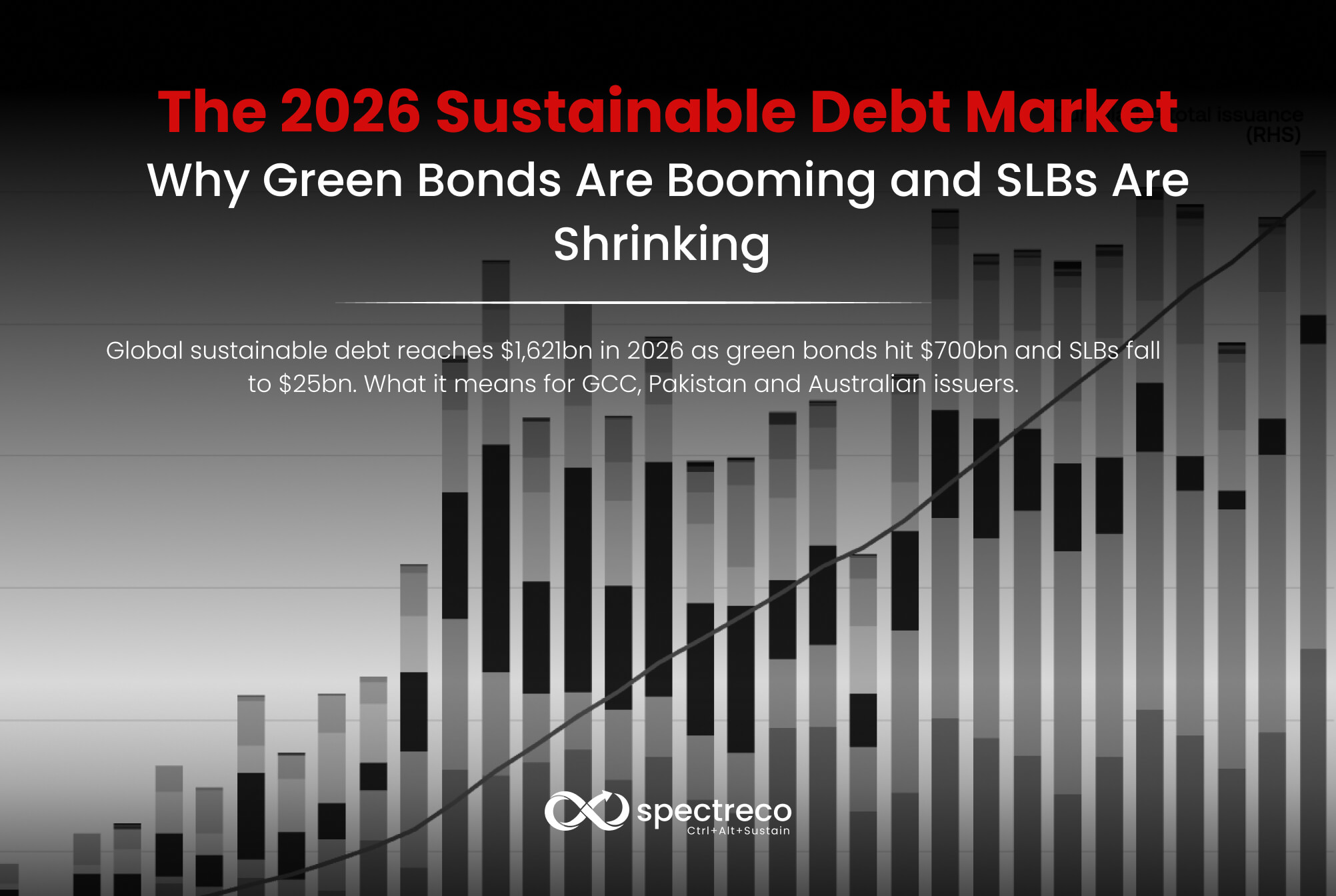
The market is pricing verification because investors were burned by soft labels and rotated into instruments they can audit. ING forecasts total global sustainable finance issuance, excluding asset-backed securities, of about US$1,621bn in 2026, up from US$1,539bn in 2025. Inside that total, the money is moving in one direction.
Green bonds lead at roughly US$700bn, green loans add around US$255bn, and sustainability bonds reach about US$290bn. Sustainability-linked loans recover to around US$160bn. Sustainability-linked bonds move the other way and fall to roughly US$25bn. ING is blunt about the cause: the KPIs linked to SLBs can fail to capture an issuer’s core sustainability impacts, and the penalties for missing targets are frequently too small to be meaningful.
Independent structural analysis explains why the penalty rarely bites. A World Bank study found that about 65 percent of SLBs are callable, against 12 percent of conventional bonds, and that call penalties average 15.4 basis points against step-up penalties of 31.2 basis points. Sixty percent of SLBs carry a penalty of exactly 25 basis points, a sign of arbitrary calibration, and the average step-up is less than 12 percent of the average coupon. Issuers built escape hatches, and investors learned to discount the label.
Sources: ING Think, Sustainable Debt Outlook 2026 | World Bank, Structural Loopholes in Sustainability-Linked Bonds
What Data and Assurance Does Each Instrument Require?
Each family asks for a different evidence stack, and the gap between them is where most issuers underestimate the work. A use-of-proceeds instrument needs project-level data before issuance. A KPI-linked instrument needs a defensible target and independent proof of performance at every observation date.
Use-of-Proceeds Requirements
- A framework aligned to the Green Bond or Green Loan Principles, published before issuance.
- An eligible-project register that maps proceeds to specific assets.
- Annual allocation reporting until proceeds are fully allocated. Under the 2025 Green Loan Principles update, this moved from a recommendation to a requirement.
- Impact metrics that quantify the environmental outcome, not just the spend.
- A pre-issuance second-party opinion (SPO) and, ideally, third-party verification of the allocation.
KPI-Linked Requirements
- KPIs that capture the issuer’s core sustainability impact, not a peripheral metric.
- Sustainability performance targets calibrated against a baseline and benchmarked for ambition.
- A coupon step-up sized to exceed the pricing benefit of the label, so the penalty actually bites.
- Annual reporting of KPI performance against each target.
- Independent verification of performance at every target observation date, not issuer self-certification.
Sources: ICMA Green Bond Principles, June 2025 | Hogan Lovells, ICMA Sustainability-Linked Bond Principles
Which Instrument Fits Your Market: GCC, Pakistan or Australia?
The right instrument is partly a function of where you issue. Each of Spectreco’s core markets has a structure that favours a use-of-proceeds approach, and a disclosure regime that rewards it.
GCC Green Sukuk
For GCC issuers, green sukuk is the natural fit because a sukuk is already a use-of-proceeds instrument. Sustainable sukuk reached a record US$11.4bn in 2025, up from US$7.9bn in 2024, and made up more than 45 percent of regional sustainable issuance by value. S&P Global has trimmed its 2026 Middle East forecast to US$15bn to US$20bn, down from US$20bn to US$25bn, citing geopolitical volatility, but the growth is still carried by green sukuk. The constraint is not appetite. It is the impact-disclosure infrastructure that turns a green label into a credible one, as covered in Spectreco’s guide to green sukuk and ESG disclosure in the GCC and its analysis of Saudi CMA disclosure rules for labelled debt.
Pakistani Corporates
Pakistan has just built the pipe for use-of-proceeds issuance. The government established its Sovereign Sustainable Finance Framework in September 2025, and issued its first sovereign green sukuk in May 2025: a PKR 30 billion, three-year Government of Pakistan Ijarah Green Sukuk. For SECP-regulated corporates, a green sukuk or green bond aligns with the country’s emerging green taxonomy, which is starting to shape the cost of capital, as set out in Spectreco’s analysis of Pakistan’s green taxonomy and the cost of capital.
Australian Corporates
Australia gives corporates a sovereign benchmark to price against. The Australian Office of Financial Management had A$10.0bn of Green Treasury Bonds on issue as of April 2026, having launched the program in June 2024. That sovereign green curve is a use-of-proceeds reference point, and a corporate green bond backed by an eligible-project register will out-price an SLB whose targets investors now discount.
Sources: Khaleej Times, S&P cuts Middle East sustainable bond forecast | Arab News, S&P Global on sustainable sukuk | Government of Pakistan, Sovereign Sustainable Finance Framework | Australian Office of Financial Management, Green Bond Program
The Decision Matrix: Matching Instrument to Profile and Market
Two questions settle most cases: do you have discrete green projects, and how mature is your data. The list below maps a decarbonisation profile to the instrument the 2026 market rewards.
- Defined green-asset pipeline (renewables, clean transport, green buildings, water): issue a green bond, green loan or green sukuk. You have the strongest 2026 demand and an auditable use of proceeds.
- Whole-entity transition, material targets, no discrete green assets: an SLB or SLL is defensible only if the KPI is core and the penalty bites. Otherwise, build the project pipeline first.
- Mixed environmental and social projects: a sustainability bond captures both without diluting the green claim.
- Bank-led or bilateral financing: a green loan or SLL keeps the same discipline inside a private facility.
Market then refines the choice. GCC issuers should default to green sukuk. Pakistani issuers can now use the sovereign framework and green taxonomy as a template. Australian corporates have a sovereign green curve to anchor pricing. In every case, the instrument you can verify beats the instrument you can only promise.
How to Choose Your Sustainable-Debt Instrument in Five Steps
Issuers can work through five steps before committing to a structure. The order matters: data readiness sits in the middle, because it decides whether the instrument you want is the instrument you can actually issue.
- Inventory your eligible projects. List the green assets you can finance or refinance. A defined pipeline points to a green bond, loan or sukuk. A thin pipeline is a signal to build projects, not to default to an SLB.
- Match the instrument to your market. Green sukuk in the GCC, a green sukuk or bond under Pakistan’s sovereign framework, a green bond against Australia’s sovereign curve. Let the local structure and disclosure regime narrow the field.
- Test your data readiness. Confirm you can produce allocation and impact reports for a use-of-proceeds deal, or verified KPI performance for a KPI-linked deal, under external assurance. If you cannot, fix the data before choosing the label.
- If KPI-linked, calibrate the KPI and the penalty. Make the KPI core to your impact and size the step-up so it exceeds the pricing benefit of the label. A penalty investors ignore signals nothing.
- Line up external review and reporting before pricing. Secure a second-party opinion, arrange third-party assurance, and set the reporting cadence in advance. Retrofitting disclosure after issuance produces weak, challengeable claims.
Frequently Asked Questions (FAQs)
The Bottom Line
The green-bond-versus-SLB decision is not really a financing choice. It is a test of whether your data can defend a sustainability claim under assurance. In 2026, capital is flowing to instruments where the environmental purpose is provable and pulling back from instruments where it is only promised. For issuers in the GCC, Pakistan and Australia, the move is to pick the instrument your data can stand behind, and to build that data before you price.
Spectreco structures green bonds, green sukuk and sustainability-linked instruments so the claim holds up with investors and regulators. Run a sustainable-finance data-readiness assessment with our Climate Finance and Green Capital team before your next issuance, backed by Spectreco’s cloud-native ESG platform and Virtual Sustainability Office.
.jpg)
More From Our Blog

.jpg)
Your ESG Journey?