

35x35: The COP31 Electrification Pledge That Forgot One Word


Electrify Everything. Just Don’t Ask What Powers It.
On 11 November 2026, at the COP31 Leaders’ Summit in Antalya, Türkiye, a group of countries endorsed the Presidency’s 35x35 pledge: raise electricity’s share of final global energy use from around 23% today to 35% by 2035. It is the clearest new item to come out of this year’s climate summit.
Source: WRI statement, 11 Nov 2026
The COP31 electrification pledge is voluntary and non-binding, and it has one gap that climate advocates spotted immediately. It does not require the extra electricity to come from low-carbon sources. Electrify everything, in other words. Just don’t ask what powers it.
Source: Al Jazeera
Spectreco is an ESG technology and advisory firm with offices in Atlanta, London, Lisbon, Dubai, Muscat and Lahore. We help companies turn climate commitments into audit-ready numbers. This article covers what the 35x35 pledge says, which word it leaves out, and the part most coverage misses: what electrifying on a fossil-heavy grid does to a company’s own Scope 2 disclosure under IFRS S2.
What Is the COP31 35x35 Electrification Pledge?
Direct answer: The 35x35 pledge is a voluntary COP31 pledge to raise electricity’s share of global final energy consumption to 35% by 2035, from around 23% today. Türkiye’s COP31 Presidency launched it, and Australia, which leads the COP31 negotiations, backs it. Countries that sign keep full control of how they electrify, including which power sources they use.
The International Energy Agency (IEA) prepared a special report for the two COP31 presidencies to test whether the target is realistic. Its headline: the goal is within reach, but only with a sharp change of pace.
The Numbers Behind 35x35
- Today: electricity meets about 23% of global final energy demand.
- Current policies: the share reaches only about 30% by 2035, according to the IEA. Climate Action Tracker puts it lower, at 28%.
- Cost-effective potential: around 33% is already cost-effective with existing technologies, which the IEA says puts 35% within striking distance.
- Pace required: Climate Action Tracker estimates electrification would need to speed up roughly four-fold.
- Grids: under the IEA’s High Electrification Scenario, grids must expand around 40% faster through 2035 than over the previous decade.
Sources: Climate Home News, Climate Action Tracker, Down To Earth on the IEA Special Report on Electrification
A Fifth or a Quarter?
Coverage quotes today’s starting point anywhere from “about one-fifth” to 23%. Both trace back to the IEA, most likely reflecting different bases and data years. For planning, the 23% figure from the IEA’s special report is the one the endorsed pledge itself uses.
Sources: Al Jazeera, WRI statement, 11 Nov 2026
Which Word Is Missing From the Pledge?
Strictly, the word “clean” is in the text. It just is not a condition. Per Climate Home News, the pledge says the use of clean electricity will vary by national circumstances, and it backs the goal with “diverse and sustainable energy sources” without saying what those are. Fossil fuels are not named, although the text cites the COP28 call to transition away from them.
Source: Climate Home News
That gap matters because the climate maths depends on it. Modelling by the International Renewable Energy Agency (IRENA) finds that 35% electrification by 2035 only fits a 1.5°C pathway if at least 78% of electricity comes from renewables. The IEA says coal generation must fall about 70%, and gas about 60%, by 2035 on that same pathway.
Sources: Heinrich Böll Stiftung, Climate Home News
Climate Action Tracker makes the same point from the other side. Without clean generation, a country could hit 35x35 simply by adding fossil-fired power. Its recommendation is to pair the target with the COP28 goals on tripling renewables and doubling efficiency.
Source: Climate Action Tracker
Electrifying on Coal: Moving the Chimney, or Something Better?
Our take: electrifying on coal is just moving the chimney. The fuel stops burning in the car, the boiler or the kiln, and starts burning at the power station instead. That line is mostly right. The useful part is knowing exactly where it is wrong.
Where the Chimney Simply Moves
Electrification cuts emissions through two levers. The grid gets cleaner, and electric equipment uses energy more efficiently than combustion. On a coal-heavy grid the first lever is switched off, so efficiency has to do all the work.
Where the swap is heat for heat at close to one-to-one, such as resistive heaters or electric boilers, there is little efficiency gain to lean on. Brand-new demand is worse. The Heinrich Böll Stiftung reports that about 70% of China’s data centre electricity comes from coal, and cites an IEA estimate that around 40% of data centres will run on fossil power by 2035.
Source: Heinrich Böll Stiftung
Where It Still Beats the Tailpipe
Transport is the counter-example. The International Council on Clean Transportation (ICCT) found that a medium-size battery electric car has lower life-cycle emissions than a comparable petrol car in all four markets it modelled: Europe, the United States, China and India. Even on India’s coal-heavy grid the saving was 19% to 34%. In China it was 37% to 45%.
Source: ICCT life-cycle study
So the sharper version of the punchline is this. Electrifying on coal moves the chimney. Efficiency decides whether the new chimney is smaller, and only a clean grid gets rid of it.
The Global Grid Is Turning, Slowly
The direction of travel helps. Ember’s Global Electricity Review 2026 found renewables supplied 33.8% of global electricity in 2025, overtaking coal at 33.0% for the first time in a century. Coal’s share fell below a third for the first time in history. That still leaves a third of the world’s power coming from coal.
Source: Ember, Global Electricity Review 2026
What Does Electrification Do to Your Scope 2 Emissions?
Direct answer: Electrification moves emissions from Scope 1, fuel burned on site, to Scope 2, purchased electricity. IFRS S2 requires Scope 2 to be disclosed on a location-based method, using the average emission factor of your grid. Electrify on a fossil-heavy grid and Scope 1 falls while Scope 2 rises.
This is where the missing word lands on your own ledger. IFRS S2 paragraph 29(a)(v) requires location-based Scope 2 emissions, plus information about any contractual instruments needed to understand them. Paragraph B30 makes the location-based figure the required one. Market-based Scope 2, which reflects power purchase agreements (PPAs) and renewable energy certificates, is optional context.
Source: AASB staff paper on Scope 2 under IFRS S2
In practice, a company cannot buy its way out of a dirty grid in the headline number. A PPA still matters, and you should disclose it. But the grid average sets the Scope 2 figure that investors and regulators compare. Data centre operators already know this problem well, as our guide to Scope 1, 2 and 3 reporting for data centres explains.
Why This Matters in Pakistan
Pakistan shows the risk clearly. Topline Research estimated that around 46% of power generation in FY25 came from re-gasified liquefied natural gas (RLNG), coal and gas. Imported coal’s share roughly doubled, from 3.40% in FY24 to 7.13% in FY25. Hydropower and nuclear supply much of the rest.
Source: The Express Tribune, citing Topline Research
Listed companies reporting under the Securities and Exchange Commission of Pakistan’s (SECP) IFRS S2 mandate will report Scope 2 against that grid mix. Before you switch a gas boiler or a diesel fleet to grid power, model what it does to both scopes. Our SECP IFRS S2 compliance guide covers the wider disclosure requirements.
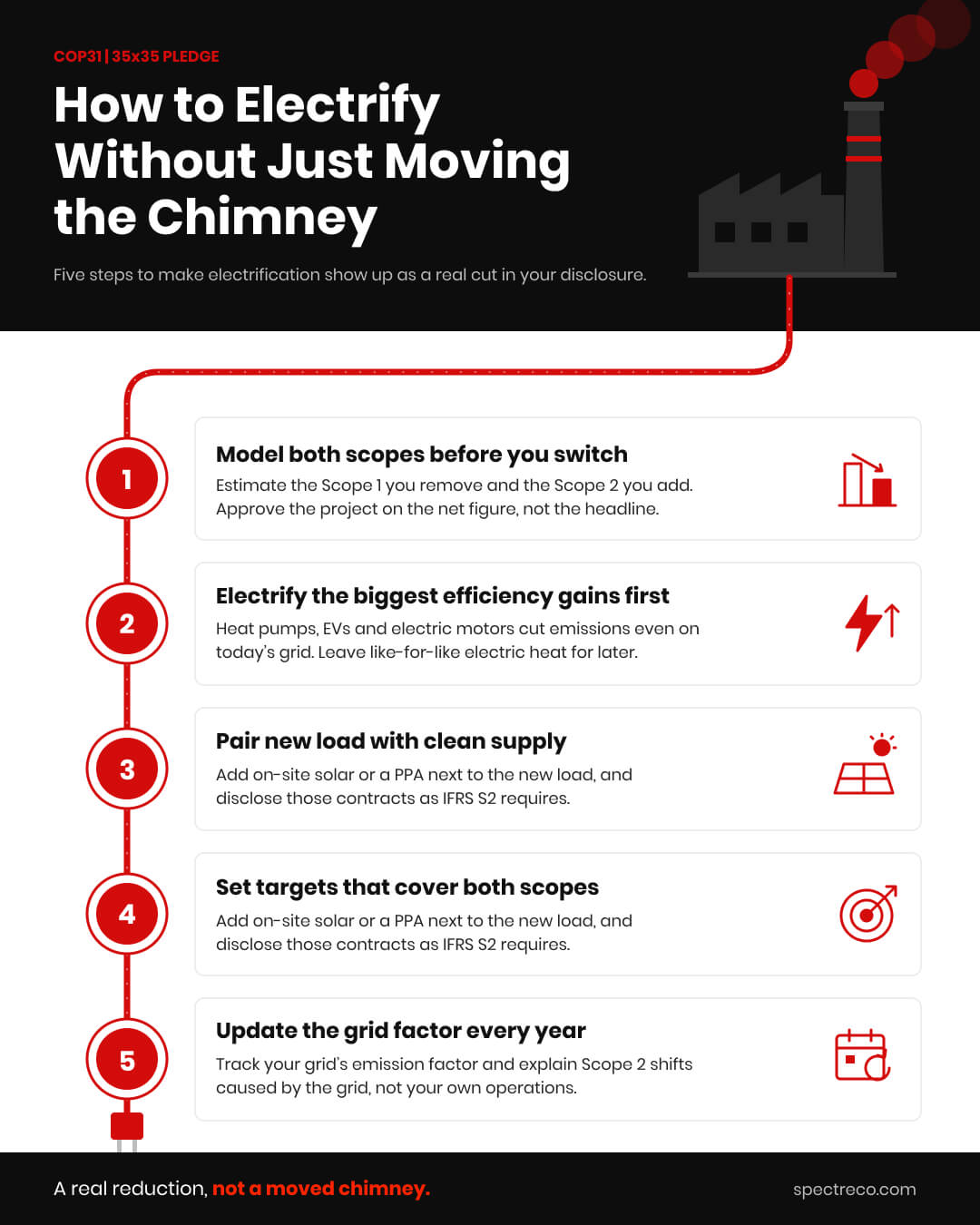
How to Electrify Without Just Moving the Chimney
Electrification is still the right direction for most companies. These five steps make sure it shows up as a real reduction in your disclosure.
- Model both scopes before you switch. Estimate the Scope 1 you remove and the Scope 2 you add at your grid’s location-based emission factor. Approve the project on the net figure, not the Scope 1 headline.
- Electrify the biggest efficiency gains first. Prioritise heat pumps, electric vehicles and electric motors, where the efficiency gain cuts emissions even on today’s grid. Leave like-for-like resistive heat until the grid is cleaner.
- Pair new load with clean supply. Add on-site solar or a PPA alongside the new load, and disclose those contracts as IFRS S2 requires. They improve your market-based figure and show investors how you are managing the location-based one.
- Set targets that cover both scopes. A Scope 1 target alone rewards moving the chimney. Our breakdown of the SBTi Corporate Net-Zero Standard V2.0 shows how to set targets that hold up in disclosure.
- Update the grid factor every year. Track your national grid’s emission factor annually and explain movements in Scope 2 that come from the grid rather than from your own operations.
Frequently Asked Questions (FAQs)
Count the Chimney Before You Move It
The 35x35 pledge leaves the clean-power question to each country. Your Scope 2 disclosure does not get that luxury. Spectreco models electrification projects across Scope 1 and Scope 2 before you commit capex, and the Spectreco platform tracks the grid factors that drive your location-based numbers year on year. Our Virtual Sustainability Office runs the programme end to end. Book a decarbonization and net-zero strategy session or request a demo to see what electrification does to your reported emissions.
Electrify, yes. Then prove the chimney got smaller.


More From Our Blog


Your ESG Journey?