

Double Materiality Assessment for CSRD: 2026 Guide

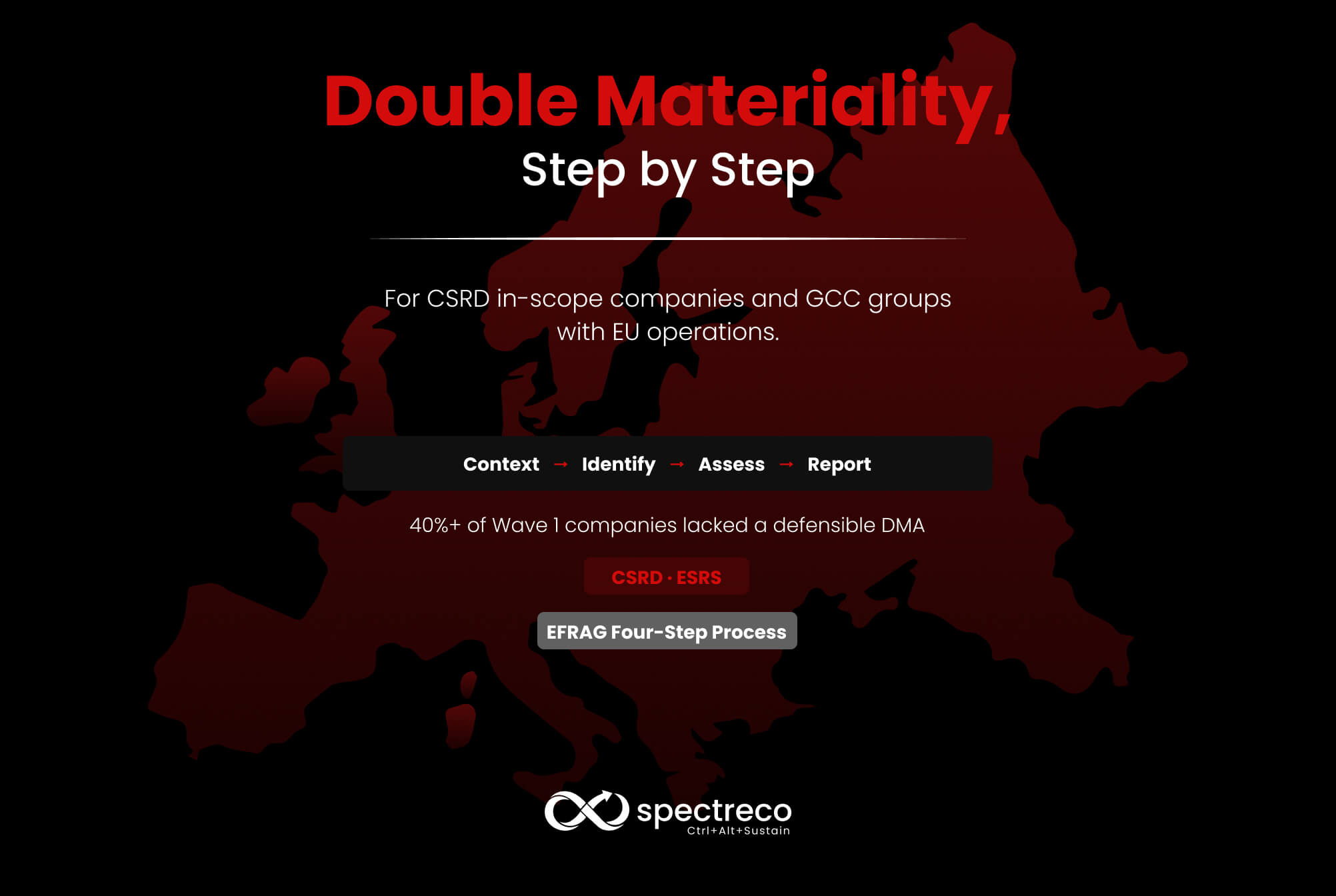
How to Conduct a Double Materiality Assessment for CSRD: A 2026 Step-by-Step Guide
The double materiality assessment is the first thing an auditor asks to see and the first thing most companies get wrong. It decides what you report under the EU's Corporate Sustainability Reporting Directive (CSRD), and a weak one falls apart under assurance. This double materiality assessment CSRD how-to guide for 2026 walks through the European Financial Reporting Advisory Group (EFRAG) four-step process, explains what changed after the Omnibus, and shows why the method differs from the single-materiality approach used across the Gulf.
Spectreco, an ESG technology and advisory firm with offices in Atlanta, London, Lisbon, and Lahore, runs these assessments for in-scope groups and for the GCC companies caught by the CSRD's reach into non-EU parents. Here is the method, the regulatory status as of mid-2026, and the mistakes that cost companies an assurance opinion.
What Is a Double Materiality Assessment?
A double materiality assessment identifies which sustainability topics a company must report under the CSRD. It evaluates each topic from two angles: how the company affects people and the environment (impact materiality), and how sustainability issues affect the company's finances (financial materiality). A topic is material if it clears either threshold.
Impact materiality (the inside-out view)
Impact materiality looks outward from the company. Under ESRS 1, a matter is impact-material when the undertaking is connected to actual or potential significant impacts on people or the environment, positive or negative, across its own operations and its upstream and downstream value chain. Severity is judged on scale, scope, and irremediable character, with likelihood added for potential impacts.
Financial materiality (the outside-in view)
Financial materiality looks inward. A matter is financially material when it creates risks or opportunities that influence the company's cash flows, financial position, access to finance, or cost of capital over the short, medium, or long term. The two lenses overlap often. A material impact frequently becomes a financial risk the moment regulators, lenders, or customers react to it.
Sources: EFRAG Implementation Guidance 1: Materiality Assessment; Generation Impact Global (ESRS 1 / IG 1).
Did the Omnibus Change the Double Materiality Requirement?
No. The Omnibus narrowed who must report, not how. Directive (EU) 2026/470, published on 26 February 2026 and in force from 18 March 2026, raised the CSRD threshold to companies with more than 1,000 employees and over EUR 450 million net turnover. Double materiality stayed mandatory.
The change removed roughly 80% of the companies that would have been in scope, leaving about 6,000 of the largest EU undertakings. The reporting clock moved too. Wave 1 companies keep reporting through 2026 under the original ESRS, while the next wave files its first report for financial year 2027 under a simplified ESRS that cuts mandatory data points by around 61%. Member States transpose the CSRD changes by 19 March 2027.
What did not move: the double materiality test, climate disclosure, and limited assurance. Treating 2026 as a year to pause is the mistake. For most teams it is a year to confirm scope and tighten the assessment before the data demands return.
Sources: European Commission (Directive (EU) 2026/470); Latham & Watkins; IntegrityNext (double materiality still mandatory).
How Double Materiality Differs from AASB S2 and the GCC's Single-Materiality Frameworks
AASB S2, Australia's climate standard, uses single (financial) materiality only. It asks how climate affects the business, judged through the eyes of investors, lenders, and creditors. CSRD's double materiality adds a second lens: how the business affects people and the planet, whether or not that impact is yet financial.
This is not a technicality. AASB S2 is built on the ISSB's IFRS S2, the same foundation used across the Gulf. Qatar, Saudi Arabia, Kuwait, Bahrain, and the UAE have aligned their disclosure regimes with ISSB single materiality. A topic that is impact-material but not financially material, such as a community's exposure to your operations, is reportable under CSRD and invisible under AASB S2 or an ISSB-based GCC regime.
For groups running both regimes at once, our breakdown of AASB S2, TCFD and CSRD for companies with global operations maps where the two methods can share one workflow rather than running twice.
Sources: Materiality Master (ISSB vs ESRS); Carbonly.ai (AASB S2 single materiality).
How to Conduct a Double Materiality Assessment: EFRAG's Four-Step Process
EFRAG's Implementation Guidance 1, finalised in May 2024, sets out an illustrative four-step process: understand the context, identify impacts, risks and opportunities, assess and score them against materiality criteria, then report. The guidance is non-authoritative, but assurance providers expect to see its logic in your file.
- Step A: Understand the context. Map your business model, activities, products, geographies, value chain, and the stakeholders affected by each. Pull from your strategy, financial statements, and existing risk register rather than starting a parallel exercise. This is the input that makes everything after it defensible.
- Step B: Identify impacts, risks and opportunities (IROs). Against the ESRS 1 sustainability topics and any entity-specific matters, list actual and potential impacts on people and the environment, then the risks and opportunities those impacts and dependencies create. Many financial risks begin life as impacts.
- Step C: Assess and score against materiality criteria. Score impact materiality on severity (scale, scope, irremediable character) and, for potential impacts, likelihood. Score financial materiality on the magnitude and likelihood of the effect on cash flows, financing, and cost of capital across time horizons. Set qualitative and quantitative thresholds before you score, not after.
- Step D: Report and document. Carry the material IROs into the sustainability statement and disclose the process under ESRS 2. Keep the evidence trail: data sources, thresholds, decisions, and who made them. Inform the board, since ESRS ties the assessment directly to governance disclosures.
Spectreco's cloud-native AI platform runs this as a guided workflow, generating the matrix and the audit trail in one place. For teams without the headcount, the Virtual Sustainability Office runs the whole cycle as an extension of your team.
Sources: EFRAG IG 1 (ESRS Knowledge Hub); Ropes & Gray (IG 1 four-step process).
What Does a Double Materiality Assessment Produce?
The DMA produces a defensible list of material impacts, risks, and opportunities, usually visualised as a materiality matrix. That list sets the scope of your sustainability statement and feeds two disclosures: ESRS 2 IRO-1 (how you ran the process) and IRO-2 (which disclosure requirements you cover).
The matrix is a communication tool, not the deliverable. ESRS does not mandate a matrix. It mandates a documented, evidence-based determination of what is material and why. The output also tells you what you can leave out, and a clear "not material" call, properly evidenced, is worth as much under assurance as a "material" one.
Sources: EFRAG IG 1 / ESRS 2 (IRO-1 and IRO-2).
Common Mistakes Companies Make in a Double Materiality Assessment
EFRAG's 2025 implementation review found that more than 40% of Wave 1 companies lacked a defensible DMA. The pattern of failure is consistent.
- Running it inside the sustainability team alone. When the assurance provider asks how a climate risk maps to a financial statement line, the CFO and risk function need to have been in the room.
- Treating it as a one-off workshop. A two-hour session and a matrix will not survive a hard question six months later. Document the reasoning as you go.
- Setting thresholds after scoring. Define qualitative and quantitative thresholds first, or the result looks reverse-engineered.
- Ignoring the value chain. Both lenses extend upstream and downstream, not just to your own operations.
- Skipping the evidence for "not material". Omitting a topic without a documented basis is the fastest route to a qualified assurance opinion.
Sources: ASUENE (EFRAG 2025 implementation review); Carbonly.ai.
Why Double Materiality Matters for GCC Companies
A Gulf-headquartered group is caught by the CSRD when it generates more than EUR 450 million in EU net turnover and has an EU subsidiary or branch with over EUR 200 million in turnover. Reporting for these non-EU parents begins with financial year 2028. The double materiality test applies even though the parent sits outside the EU.
Most GCC reporting regimes follow ISSB single materiality, so a Gulf energy major, bank, or developer with European operations has to run two methods at once: financial materiality at home and double materiality for the EU. The cost-of-capital argument makes this more than a compliance task. With the GCC on track for USD 20 to 25 billion in sustainable bond issuance in 2026, a credible, double-materiality-backed disclosure is increasingly what lenders and bond investors expect to see.
Spectreco works on the ground in the region. Our guides to Qatar's IFRS S1 and S2 requirements and Saudi Arabia's ISSB-aligned reporting cover the single-materiality home regimes, while the Climate and Green Finance practice connects the assessment to capital access.
Sources: Council of the EU (third-country thresholds); EFRAG (Non-EU Groups standard-setting).
Frequently Asked Questions (FAQs)
Get Your CSRD Double Materiality Assessment Right the First Time
Spectreco's Compliance, Reporting and Disclosures team designs and runs CSRD-ready double materiality assessments, from the context map to the audit trail your assurance provider will test. Request a consultation to scope yours before the next reporting cycle, or browse more regulatory guides in our Insights library.
.jpg)
.jpg)
More From Our Blog


Your ESG Journey?