

The EU Omnibus Trap: ESG Reporting Is Not Optional

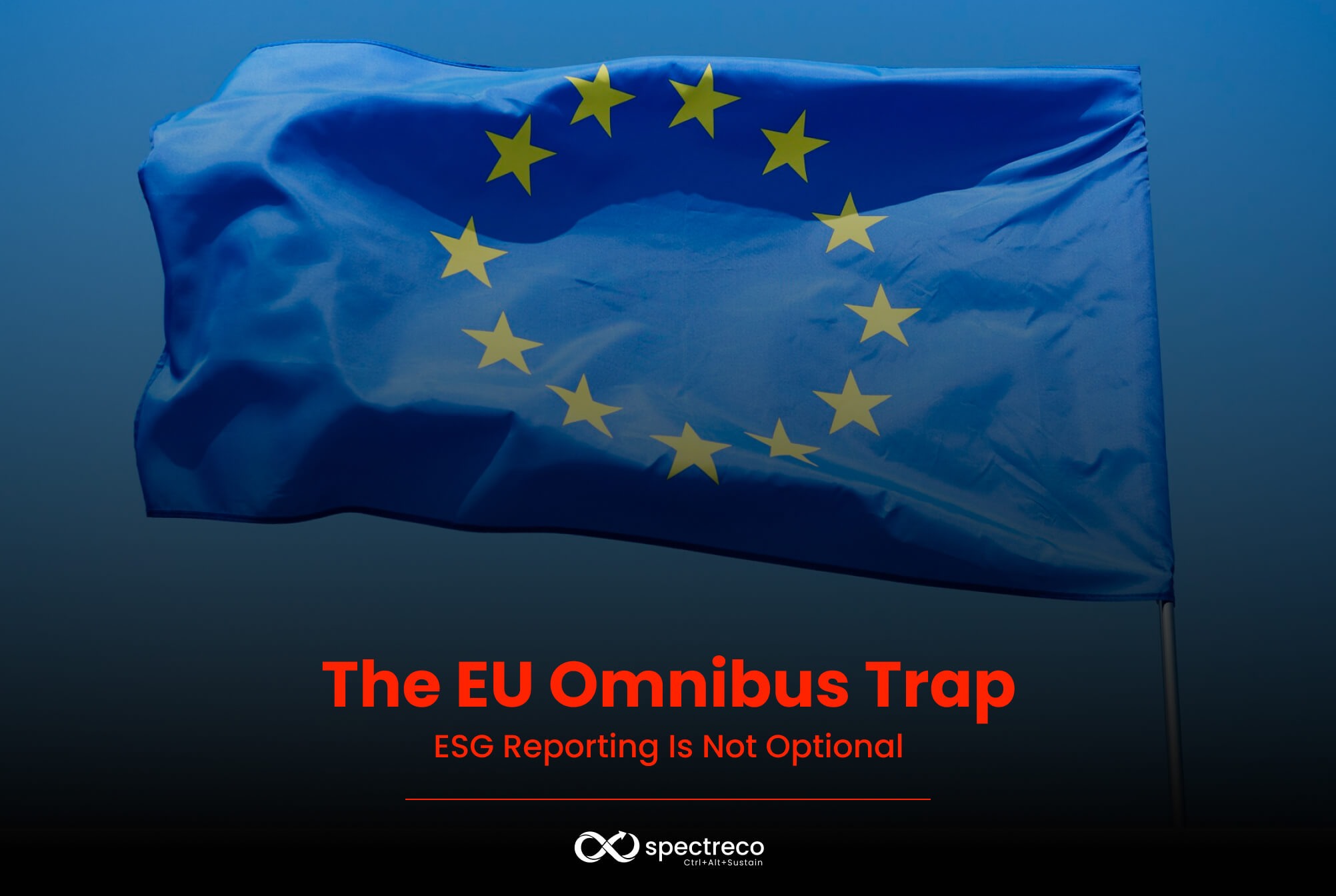
The EU Omnibus Trap: Why "Out of Scope" Does Not Mean Out of the Market
The Corporate Sustainability Reporting Directive (CSRD), the EU's mandatory sustainability reporting law, was expected to pull roughly 50,000 companies into formal ESG disclosure for the first time. Then Directive (EU) 2026/470, known as the Omnibus I Directive, changed that picture significantly.
Published in the Official Journal of the European Union on 26 February 2026 and in force from 18 March 2026, Omnibus I raised CSRD thresholds sharply and removed a large share of previously expected reporters from mandatory scope. For many mid-market companies, procurement teams, and finance directors, the immediate reaction was relief.
That reaction is understandable. It is also incomplete. Spectreco, an ESG technology and advisory firm with offices in Atlanta, Lisbon, Dubai, Muscat, and Lahore, works with clients across the EU, GCC, UK, Pakistan, and Australia. The pattern we see after Omnibus I is consistent: companies that interpret a regulatory exemption as permission to stop building ESG capability are creating a different kind of risk, commercial, reputational, and financial, that the directive change does not remove.
This article explains what Omnibus I actually changed, what it did not change, and what the right strategic response looks like for companies now sitting outside the mandatory CSRD perimeter. For how parallel regulatory shifts are affecting GCC operations, see Spectreco's analysis of the UAE climate law and GCC ESG compliance timeline.
What the EU Omnibus I Directive Actually Changed
The new CSRD scope
Under the original CSRD framework, any large undertaking meeting two of three criteria 250 or more employees, EUR 50 million or more in net turnover, EUR 25 million or more on the balance sheet was expected to report. The Omnibus I Directive replaced that structure with a narrower dual threshold.
CSRD now applies to EU undertakings that exceed both of the following criteria simultaneously:
- More than 1,000 employees on average during the financial year
- More than EUR 450 million in net annual turnover
Source: Directive (EU) 2026/470 Official Journal of the EU, 26 February 2026, EU Council approves Omnibus I Directive, March 2026
Both conditions must be satisfied. A company with 2,000 employees and EUR 300 million in turnover is out of scope. So is a EUR 600 million revenue business with 900 employees.
For non-EU parent groups, the updated rules apply where the parent generates more than EUR 450 million in EU net turnover and has either an EU subsidiary with more than EUR 200 million in net turnover or an EU branch meeting specified thresholds.
Source: Linklaters Sustainable Futures: EU Omnibus I Directive published in the Official Journal, February 2026, Garrigues: Publication of Directive (EU) 2026/470, April 2026
What else was removed or changed
Omnibus I also:
- Removed the Commission's power to adopt mandatory sector-specific European Sustainability Reporting Standards (ESRS), so the standards stay cross-sector
- Exempted listed SMEs from CSRD reporting entirely
- Introduced a statutory right for value-chain companies with up to 1,000 employees to refuse ESG information requests that go beyond the voluntary standard for smaller companies
- Expanded the ability to omit commercially sensitive or security-related information in defined circumstances
- Required the European Commission to adopt voluntary sustainability reporting standards for undertakings below the 1,000-employee threshold by no later than July 2026. The Commission adopted it on 3 July 2026 and it entered into force on 24 September 2026
Source: Accountancy Europe: Omnibus explained key changes to the CSRD and CSDDD, White & Case: Simplified, not abandoned EU Corporate Sustainability after Omnibus I, March 2026
Member States may also introduce a transitional exemption for companies that were previously in scope as "wave one" reporters but now fall below the revised thresholds for financial years beginning 1 January 2025 or 2026.
Source: Council of the EU: Council signs off simplification of sustainability reporting, February 2026
What the "80%" figure actually means
The claim that Omnibus I reduced CSRD scope by 80% has circulated widely. The underlying direction is correct: the scope contraction is substantial and removes a very large share of previously expected reporters from mandatory obligation. Estimates from legal and market sources put the reduction at approximately 80 to 90 percent of originally expected reporters. The exact figure depends on assumptions about which wave cohorts are counted and how transitional exemptions are applied at Member State level.
The number is useful shorthand for the scale of change. It is not a guarantee for any specific company, and it should never be read as a signal that ESG is now optional.
Source: financialregulations.eu: EU Omnibus Package 2026 CSRD Scope Reduced by 80%, March 2026, Dcycle: CSRD Omnibus I approved what changes for companies, February 2026
Does the Exemption Eliminate ESG Expectations?
A company may no longer be legally required to publish a sustainability report under CSRD. The more pressing commercial question is whether its customers, lenders, and investors have also stopped asking for ESG data. In most mid-market industrial and financial ecosystems, they have not.
The value-chain cap and what it does not cover
Omnibus I introduced a statutory "value-chain cap", a formal protection for companies with up to 1,000 employees that gives them the legal right to refuse ESG information requests beyond the essential datapoints in the voluntary standard, applying from financial years beginning on or after 1 January 2027.
That protection matters. It creates a ceiling on the most burdensome data extraction demands from larger counterparties. It does not, however, eliminate all ESG data requests. In-scope companies still need supplier sustainability information to support their own disclosures, including materiality assessments, Scope 3 emissions accounting, and value-chain due-diligence evidence.
The Omnibus reform caps excessive requests. It preserves a channel for proportionate ESG data collection across the value chain. For a detailed look at exactly which data points large companies continue to request from suppliers, see Spectreco's article on Scope 3 supplier data and CSRD value-chain obligations.
Source: Morrison Foerster: EU Sustainability Omnibus I What the Final CSRD/CSDDD Deal Means for Companies, December 2025, Position Green: FAQ The Omnibus process and how it affects your reporting now, 2025
Commercial pressure is not the same as legal obligation
Procurement scoring, tender requirements, preferred supplier qualification criteria, and ESG-linked contract clauses are not EU regulations. They are contractual conditions set by customers. Omnibus I does not change those.
A supplier that cannot answer basic questions about carbon emissions, labour practices, governance controls, or incident history may still lose preferred supplier status, be excluded from bid consideration, or score poorly in sustainability audits that determine supply chain tiering.
The legal risk of not filing a CSRD report is gone, for those now outside scope. The commercial risk of not maintaining ESG capability is not.
Spectreco's Compliance, Reporting and Disclosures advisory service helps companies design right-sized reporting frameworks that satisfy counterparty expectations without carrying unnecessary overhead.
Source: IntegrityNext: CSRD Omnibus Update 2026 ESRS Simplification Explained, March 2026
Why Scope 3 Keeps ESG Data Requests Alive
Scope 3 emissions, all indirect emissions across the value chain, including upstream supplier emissions and downstream product use, remain one of the primary reasons larger companies continue to request ESG data from their supply base.
For most manufacturing companies, Scope 3 is the largest component of the total carbon footprint. Where upstream emissions are material to the reporting entity's own disclosures, supplier-specific data is far more accurate than broad estimates or sector averages. The revised ESRS allow companies to rely on secondary data and proxies for Scope 3, but first-party supplier data remains preferable where obtainable.
Source: Normative: CSRD Explained (2026) Requirements, Scope & How to Comply, IntegrityNext: CSRD Omnibus Update 2026 ESRS Simplification Explained, March 2026
This means out-of-scope companies may still receive and commercially need to answer, questions about:
- Greenhouse gas emissions: Scope 1, 2, and upstream Scope 3
- Energy sources and consumption
- Labour practices, working conditions, and incident rates
- Governance policies and management accountability
- Supplier audit status and social compliance certifications
Omnibus I changed who must publish under CSRD. It did not change the emissions accounting that makes Scope 3 supplier data relevant throughout industrial supply chains. The Spectreco Platform helps suppliers collect and structure this data centrally, so a single dataset answers multiple customer requests consistently.
What Do Investors and Lenders Still Expect After Omnibus I?
Capital providers and ESG data
Banks, private equity firms, and institutional investors continue to use ESG information to assess resilience, governance quality, climate exposure, and long-term value creation. The Omnibus I scope change does not alter this. Financial institutions operating under the Sustainable Finance Disclosure Regulation (SFDR) must still substantiate sustainable finance claims, report financed emissions, and manage portfolio-level climate risk, all of which require credible ESG data from borrowers and investee companies.
Credible ESG data from portfolio companies is the input that makes those disclosures possible. A financial institution cannot report meaningfully on climate exposure in its loan book if the underlying businesses have stopped collecting emissions data.
Spectreco works directly with banks, asset managers, and insurers on financed emissions accounting and portfolio-level sustainability data. See the Financial Institutions ESG solutions page for how we structure this work.
Source: White & Case: Simplified, not abandoned EU Corporate Sustainability after Omnibus I, March 2026, Position Green: FAQ The Omnibus process and how it affects your reporting now, 2025
The private equity context
For private equity firms, the relevant question is not whether a portfolio company is currently subject to a mandatory reporting obligation. The question is whether the business can demonstrate reliable ESG controls, defensible data, and a credible improvement trajectory when capital is being priced, screened, or diligenced.
Omnibus I does not reduce what a buyer asks for in due diligence. It does not change what a lender requires before pricing a sustainability-linked loan. It does not affect the ESG scoring used in exit processes or secondary transactions.
A mid-market company that dismantles its ESG reporting infrastructure following Omnibus I may find that the next capital raise, refinancing, or trade sale surfaces a data gap that is expensive to fill under time pressure.
A market divide is forming
The strategic risk in the post-Omnibus environment is not that ESG expectations disappear. The risk is that a market divide forms between companies that treat the regulatory exemption as a reason to scale back ESG capability, and companies that use the breathing room to build leaner but more credible reporting systems.
In capital markets, the second group will have a consistent advantage: faster due diligence, better access to sustainability-linked financing, and stronger positioning for exit.
Source: Dcycle: CSRD Omnibus I approved what changes for companies, February 2026

Does Reducing ESG Reporting Create Greenwashing Exposure?
Reduced CSRD scope is not the same as reduced scrutiny of sustainability claims. Regulatory and supervisory attention across the EU has shifted toward anti-greenwashing enforcement, particularly where public claims about environmental performance are not matched by robust evidence, consistent methodology, or auditable data.
This is a specific and underappreciated risk for companies that continue to use sustainability language in investor materials, bid documents, websites, or marketing, while simultaneously reducing the discipline behind their underlying data collection.
The legal risk vector in that scenario comes less from failure to file a CSRD report. It comes from reputational damage, client challenge, investor concern, or a regulatory finding that claims were overstated or not substantiated. For a full analysis of the proposed EU Green Claims Directive and what it would require from companies making public environmental claims, see Spectreco's article on EU greenwashing risk and the Green Claims Directive.
A safer posture is selective precision: fewer public sustainability claims, stronger substantiation for the claims that remain, and internal controls over definitions, evidence sources, and accountability frameworks. Companies that continue claiming strong ESG credentials after removing the underlying reporting infrastructure face the worst of both outcomes, reduced legal protection and unchanged reputational exposure.
Source: White & Case: Simplified, not abandoned EU Corporate Sustainability after Omnibus I, March 2026, financialregulations.eu: EU Omnibus Package 2026, March 2026
How to Build the Right ESG Response to Omnibus I
The strongest post-Omnibus response is not to abandon ESG reporting. It is to redesign it around commercial relevance. The goal is a focused, materiality-based framework that satisfies customers, capital providers, and key counterparties without carrying the full administrative weight of a large-company CSRD disclosure.
Step 1: Clarify who still asks and for what
The starting point is a straightforward audit: which customers, lenders, and investors are currently requesting ESG data? What are they asking for specifically? Which of those requests are linked to contract conditions, tender scoring, or financing terms?
The answer to those questions defines the minimum viable ESG disclosure set. For most mid-market industrial suppliers, it will include:
- Greenhouse gas emissions: Scope 1 and 2, with Scope 3 where material or required by key customers
- Energy consumption and, where relevant, renewable energy share
- Workforce indicators: headcount, health and safety incident rates, turnover
- Governance: anti-bribery and corruption policies, management accountability, board-level oversight
- Incident controls: environmental incidents, product quality, supply chain compliance
Step 2: Prepare for the voluntary SME standard
The European Commission adopted a voluntary sustainability reporting standard for undertakings below the 1,000-employee threshold on 3 July 2026, and it entered into force on 24 September 2026. This standard now provides the reference baseline for proportionate ESG data requests from in-scope companies to their value-chain partners.
Companies that align with this standard early will be positioned to respond efficiently to value-chain requests without building bespoke responses for each customer questionnaire. Spectreco's Compliance, Reporting and Disclosures advisory service is already helping clients map their current ESG data against the expected VSME baseline so they are ready now that the standard has been published.
Source: Accountancy Europe: Omnibus explained key changes to the CSRD and CSDDD, Council of the EU: Council signs off simplification of sustainability reporting, February 2026
Step 3: Invest in data infrastructure, not reporting volume
The most common ESG reporting failure in the mid-market is not lack of commitment. It is fragmented data: emissions collected in one spreadsheet, labour data in HR systems, governance policies in a filing cabinet, and no consistent methodology linking any of it.
Technology platforms designed for structured ESG data collection lower reporting costs substantially, improve consistency across time periods, and support auditability. The Spectreco Platform aligns with GHG Protocol methodology and supports ESRS and VSME data points, making continued reporting manageable even for companies no longer subject to the full CSRD framework.
Step 4: Align claims with evidence
Any public sustainability claim in investor materials, on the company website, in bid responses, should be reviewed against the evidence base that now sits behind it. If Omnibus I has led to reduced data collection, some claims may no longer be substantiated to the standard that regulators and counterparties expect.
Removing a claim is far less damaging than defending an unsubstantiated one.
Audience-Specific Perspectives on Omnibus I
For EU mid-market industrial suppliers
The regulatory step-back is real. The customer expectations are not. A supplier that cannot answer basic ESG questions on greenhouse gas emissions, labour standards, or governance controls may still lose preferred status, be excluded from tender scoring, or be deprioritised by sustainability-conscious buyers.
The practical priority is not comprehensive CSRD-style disclosure. It is a credible, auditable baseline covering the data points your most important customers are asking for built in a way that can be maintained without consuming disproportionate internal resources.
For global private equity and lenders
Omnibus I changes the compliance perimeter of CSRD. It does not change the due diligence standard, the investment case for credible ESG data, or the financing conditions attached to sustainability-linked instruments. Portfolio companies that maintain disciplined sustainability reporting are systematically easier to diligence, finance, and position for exit than those that go dark.
Spectreco works with PE firms and lenders across the EU, GCC, and UK on ESG data architecture, portfolio-level emissions accounting, and investor-grade reporting. See the Financial Institutions ESG solutions page for how we support this work.
For C-suite executives across sectors
The board-level question after Omnibus I is not "Are we still legally required to report?" The more useful question is: "What level of ESG disclosure do our most important customers, capital providers, and counterparties still expect from us and can we credibly demonstrate that we meet it?"
ESG reporting, for companies in this position, is no longer a pure compliance exercise. It is market infrastructure. The companies that build it well will access capital more efficiently, win procurement decisions at the margin, and carry less reputational risk when sustainability claims are scrutinised.
Source: Official Journal of the EU
Source: Linklaters Sustainable Futures
Source: Position Green
Source: Morrison Foerster
Source: Accountancy Europe
Source: White & Case
Source: IntegrityNext
The Next Step for Your Business
Many leadership teams are now working through the same question: how much ESG capability is the right amount, given that the mandatory reporting obligation has changed? The answer depends on your customer base, financing structure, and market positioning not on the CSRD scope threshold alone.
Spectreco's ESG Reporting Advisory team works with mid-market companies, PE-backed businesses, and financial institutions to design focused, commercially relevant ESG reporting frameworks. If your team is re-evaluating its post-Omnibus ESG strategy, contact Spectreco's advisory practice to discuss a materiality-based approach that meets market expectations without carrying unnecessary reporting overhead.
You can also explore how the Spectreco Platform and our Compliance, Reporting and Disclosures advisory service support companies through regulatory transitions like this one. The full library of Spectreco ESG insights is available at the Insights hub.


More From Our Blog

Your ESG Journey?