

GHG Protocol's Scope 3 Overhaul: The 95% Coverage Rule and New Category 16 Explained

GHG Protocol’s Scope 3 Overhaul: The 95% Coverage Rule and New Category 16 Explained
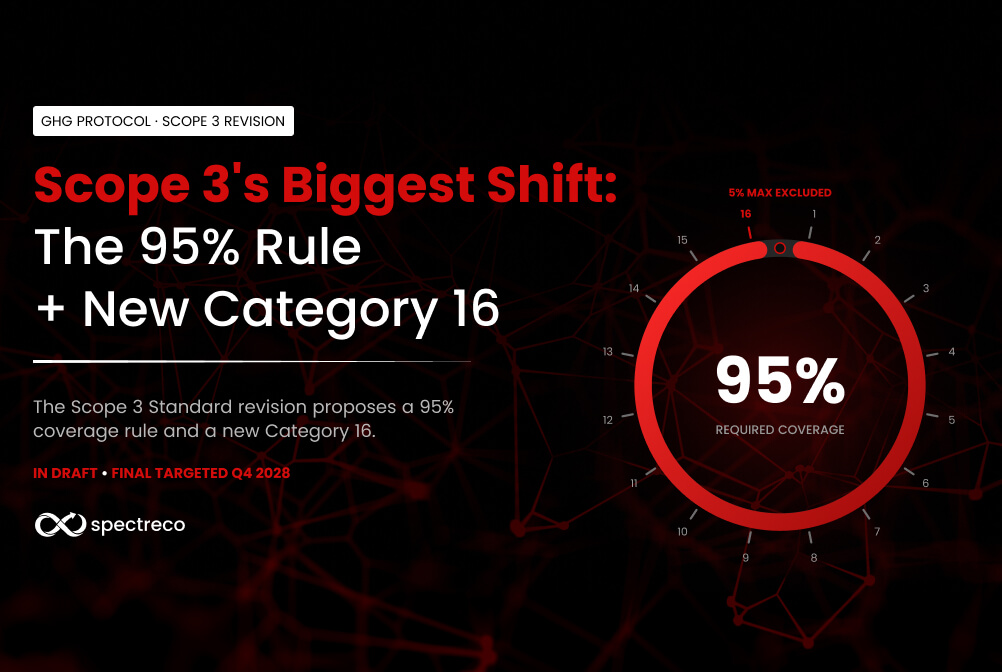
Every company that reports Scope 3 emissions may soon have to show it has covered at least 95% of them. That is the headline of the GHG Protocol Scope 3 Standard revision, a set of proposals published on 31 March 2026. It would replace a judgement call on completeness with a number an assurance provider can test.
Spectreco, a US-headquartered sustainability technology and advisory company with offices in Atlanta, London, Lisbon, and Lahore, sees this as the biggest carbon accounting methodology story of 2026. Scope 3 emissions are the indirect greenhouse gas (GHG) emissions across a company’s value chain, outside its own operations and purchased energy.
One point up front: these are proposals, not final rules. The GHG Protocol’s own document says all content is draft and subject to change, and a full public consultation draft is still to come. Do not rebuild a baseline on them yet. Do use them to find where your Scope 3 data is weak.
What Is Changing in the GHG Protocol Scope 3 Standard?
The GHG Protocol is proposing four changes to its Scope 3 Standard. Companies would account for at least 95% of required emissions. A new Category 16 would cover facilitated activities. Category 15 would narrow to investments, and reporting would be disaggregated with verification labels. All of this is draft, not final.
What the March 2026 Progress Update Is
The GHG Protocol is the most widely used global standard for measuring GHG emissions. In March 2026 it published the “Scope 3 Standard Revisions: Phase 1 Progress Update,” prepared by its Scope 3 Technical Working Group of 65 members from more than 20 countries. The group held 42 meetings between September 2024 and the end of 2025.
Sources: GHG Protocol, Scope 3 Standard Revisions: Phase 1 Progress Update, March 2026, GHG Protocol, Scope 3 Standard Revisions Phase 1 Progress Update (31 March 2026)
The document is a progress report, not a draft standard. It states plainly that it is “not a GHG Protocol Standard.” The Independent Standards Board (ISB) approved its release but has not yet been asked to approve a draft for public consultation.
Source: GHG Protocol, Scope 3 Standard Revisions: Phase 1 Progress Update, March 2026
The Four Proposals at a Glance
- 95% completeness: report at least 95% of total required Scope 3 emissions, with exclusions capped at 5%.
- New Category 16: “Other Value Chain Activities” for facilitated activities, mostly optional and reported separately.
- Narrower Category 15: investments only, with insurance and underwriting activities moving to Category 16.
- Disaggregation and verification labels: emissions split by data type, with a verified, partially verified or not verified label.
Sources: GHG Protocol, Scope 3 Standard Revisions: Phase 1 Progress Update, March 2026, ESG Today, “GHG Protocol Outlines Proposed Changes to Scope 3 Reporting Standard,” 9 April 2026
What Is the 95% Scope 3 Coverage Rule?
Under the proposal, a company must account for and report at least 95% of its total required Scope 3 emissions. It may exclude no more than 5%. The rule covers required emissions only, not optional ones. A company must quantify its total required Scope 3 emissions to justify any exclusion.
Source: GHG Protocol, Scope 3 Standard Revisions: Phase 1 Progress Update, March 2026
From Justified Exclusions to a Numeric Threshold
Today a company can exclude a Scope 3 source if it discloses and justifies the exclusion. ESG Today reports that the 95% rule would replace that language. The test shifts from “is your reason good enough?” to “is your excluded share under 5%?”
Source: ESG Today, “GHG Protocol Outlines Proposed Changes to Scope 3 Reporting Standard,” 9 April 2026
That shift matters to assurance providers. A judgement is hard to test. A percentage is not.
It also matters because Scope 3 is often where most emissions sit. In 2023, corporates reported Scope 3 supply chain emissions that were, on average, 26 times their direct operational emissions, according to CDP. A gap of a few percentage points can hide a very large number.
Why Quantifying Comes Before Excluding
Revision B2 says companies “shall quantify total required scope 3 emissions to justify exclusions.” Any method may be used, including hotspot analysis.
Source: GHG Protocol, Scope 3 Standard Revisions: Phase 1 Progress Update, March 2026
This is the cost the headline hides. The 5% is a share of a total that only exists once every required category has been estimated. A company that has never screened Category 11, the use of sold products, cannot prove it is under 5%.
In our view, this is the real change. The 95% rule is less about covering more sources and more about forcing a quantified denominator. A company that cannot show its total cannot defend a single exclusion.
What the 95% Rule Does Not Cover
- Optional emissions: the draft states that the 95% inclusion requirement does not apply to optional Scope 3 emissions.
- Intermediate products: downstream emissions in Categories 9, 10, 11 and 12 may be excluded if end use is unknown or cannot be reasonably estimated, outside the 5% cap (Revision B9).
- Investments: investments in Category 15 are required but may be excluded if they fall within the 5% threshold (Revisions C5 and C7).
Source: GHG Protocol, Scope 3 Standard Revisions: Phase 1 Progress Update, March 2026
What Is Category 16, Other Value Chain Activities?
Category 16 is a proposed new Scope 3 category called Other Value Chain Activities. It covers facilitated activities. These are third-party activities where a company earns transactional income but never buys, sells or owns the activity. Most of it is optional. It is reported separately from required emissions.
Source: GHG Protocol, Scope 3 Standard Revisions: Phase 1 Progress Update, March 2026
Facilitated Activities Explained
The draft defines facilitated activities as emissions from third-party activities where the reporting company “earns direct, transactional income but never buys, sells, or owns the activity.” The progress update gives brokerage models and many financial services as examples.
Source: GHG Protocol, Scope 3 Standard Revisions: Phase 1 Progress Update, March 2026
The 15 existing categories do not clearly cover these activities. Category 16 gives that income a home without forcing it into a category that does not fit.
Licensing and Other Subcategories
- Licensing: a licensor reports the Scope 1, 2 and 3 emissions of the activities facilitated by its licensing.
- Insurance-associated activities: moved from Category 15 (Revision C3).
- Underwriting and issuance: moved from Category 15.
- Other financial activities and services: moved from Category 15 (Revision C4).
Source: GHG Protocol, Scope 3 Standard Revisions: Phase 1 Progress Update, March 2026
Most subcategories are optional “to promote feasibility.” The draft’s one stated exception is for oil and gas distributors, who would have to report.
Source: GHG Protocol, Scope 3 Standard Revisions: Phase 1 Progress Update, March 2026
Optional Does Not Mean Invisible
Revision B7 requires companies to disaggregate required from optional Scope 3 emissions and report them separately. The GHG Protocol says this improves transparency, benchmarking and potential comparability across companies.
Source: GHG Protocol, Scope 3 Standard Revisions: Phase 1 Progress Update, March 2026
In our view, a licensor or broker that chooses to report Category 16 will set a disclosure norm for its peers. Optional categories can become expected once a few large reporters publish them.
How Does the Narrower Category 15 Change Financed Emissions Reporting?
Category 15 covers investments. For banks, insurers and asset managers, this is where financed emissions sit: the emissions attributable to loans and investments. Measuring them commonly follows the methodology of the Partnership for Carbon Accounting Financials (PCAF), which we cover in our guide to PCAF readiness for Omani banks.
The March 2026 proposals change Category 15 in four ways:
- Investments only: Category 15 would be limited to investments, meaning financed emissions.
- Activities moved out: insurance-associated activities, underwriting and issuance, and other financial activities and services move to Category 16.
- All companies: ESG Today reports that Category 15 would apply to all companies, not just investment managers.
- Investee Scope 3: the required boundary for investments would include investee Scope 3 emissions (Revision C6).
Sources: GHG Protocol, Scope 3 Standard Revisions: Phase 1 Progress Update, March 2026, ESG Today, “GHG Protocol Outlines Proposed Changes to Scope 3 Reporting Standard,” 9 April 2026
The ISSB Is Drawing a Similar Line
On 11 December 2025, the International Sustainability Standards Board (ISSB) amended IFRS S2 (Climate-related Disclosures). Entities may now limit Scope 3 Category 15 measurement and disclosure to financed emissions as defined in IFRS S2. The amendments apply to reporting periods beginning on or after 1 January 2027.
Source: IFRS Foundation, “ISSB issues targeted amendments to IFRS S2,” 11 December 2025
Two standard-setters are narrowing the same category by different routes. Our analysis of the ISSB change, and what it means for GCC banks and insurers, is in ISSB Amends IFRS S2: Scope 3 and GHG Reliefs for 2027.
What Banks and Insurers Should Watch
Under the proposal, an insurer’s underwriting emissions would sit in an optional category and be reported separately. A bank’s financed emissions would stay required, but the boundary would reach into investee Scope 3. In our view, the second point raises data demands more than the first lowers them.
How Do Disaggregation and Verification Labels Change Scope 3 Reporting?
Disaggregation by Data Type
Revision A1 says companies “shall disaggregate scope 3 emissions” using classification rules. Two options are still under consideration. One separates specific activity data and factors from spend-based estimates. The other classifies by the combination of data source and calculation method.
Source: GHG Protocol, Scope 3 Standard Revisions: Phase 1 Progress Update, March 2026
Verdantix reads this as making the share of spend-based estimates visible as a measure of credibility. That is a fair reading. A spend-based figure is a placeholder, and the proposal would put a label on it.
Verification Labels
Revision A2 says companies “shall report whether reported scope 3 emissions data was verified by a third party.” The labels are verified, partially verified and not verified. They apply where a company has had some of its data verified.
Source: GHG Protocol, Scope 3 Standard Revisions: Phase 1 Progress Update, March 2026
Data Quality Targets
The draft goes further with recommendations. Companies “should” set data quality improvement targets, either year-on-year or over a mid-term horizon (Revision A7). They should also set goals for the minimum share of emissions drawn from specific or primary data (Revision A6).
Source: GHG Protocol, Scope 3 Standard Revisions: Phase 1 Progress Update, March 2026
Verdantix notes that this reframes Scope 3 as a multi-year operational programme rather than an annual disclosure exercise.
When Will the Revised Scope 3 Standard Be Finalised?
No final date exists for the Scope 3 revisions on their own. The GHG Protocol and ISO plan one combined corporate standard. An integrated public consultation is planned for Q2 2027, with publication targeted for Q4 2028. The 2011 Scope 3 Standard remains the published standard until then.
Sources: GHG Protocol, “Key Standard Development Updates: FAQ Resource”, GHG Protocol, “GHG Protocol Announces Key Standard Development Updates,” 29 July 2026
The Timeline So Far
- 31 March 2026: the GHG Protocol publishes the Phase 1 Progress Update.
- 29 July 2026: the GHG Protocol and the International Organization for Standardization (ISO) announce plans to combine their corporate carbon accounting standards, including the Scope 3 Standard.
- Q2 2027: planned integrated public consultation on the combined standard.
- Q4 2028: targeted publication of the consolidated joint corporate standard.
Sources: GHG Protocol, Scope 3 Standard Revisions: Phase 1 Progress Update, March 2026, GHG Protocol, “GHG Protocol Announces Key Standard Development Updates,” 29 July 2026, GHG Protocol, “Key Standard Development Updates: FAQ Resource”
The dates have already moved once. A September 2025 ISSB staff paper expected the revisions to complete between Q4 2027 and Q1 2028. Trellis reported in July 2026 that the Scope 3 consultation draft, once due in the second half of 2026, may be adjusted to align with the ISO work.
Sources: IFRS Foundation, ISSB staff paper on GHG Protocol revisions (SSAF AP4), September 2025, Trellis, “GHG Protocol adjusts standards update timelines,” 29 July 2026
Two caveats matter. As at 5 October 2026, the GHG Protocol’s consultation page lists no open Scope 3 consultation. And the July announcement does not say whether the Phase 1 proposals will carry into the combined standard unchanged. Treat every detail in this article as provisional.
Sources: GHG Protocol, Feedback Opportunities (public consultations), GHG Protocol, “GHG Protocol Announces Key Standard Development Updates,” 29 July 2026
Does the Revision Apply to AASB S2, SECP, UK SRS and CSRD Reporters?
IFRS S2, AASB S2 and SECP Reporters
Not automatically. IFRS S2 names the standards it relies on. Paragraph 29(a)(ii) requires entities to measure GHG emissions in accordance with the GHG Protocol Corporate Standard (2004). Paragraph 29(a)(vi)(1) points to the Scope 3 categories in the Corporate Value Chain (Scope 3) Standard (2011).
Source: ISSB, Amendments to Greenhouse Gas Emissions Disclosures (IFRS S2), December 2025
An ISSB staff paper from September 2025 confirms the consequence. Revisions to the GHG Protocol will not automatically apply to IFRS S2. The ISSB must decide whether to propose an amendment to update the reference, and any amendment would go to public consultation.
Source: IFRS Foundation, ISSB staff paper on GHG Protocol revisions (SSAF AP4), September 2025
The same logic reaches Australia, where AASB S2 (Australian Sustainability Reporting Standard S2: Climate-related Disclosures) requires measurement under the 2004 Corporate Standard. BDO Australia also notes that entities may elect not to disclose Scope 3 emissions in their first year of applying AASB S2.
Source: BDO Australia, “Transition relief for Scope 3 GHG disclosures,” 18 May 2026
In Pakistan, the Securities and Exchange Commission of Pakistan (SECP) notified IFRS S1 and S2 in phases beginning with annual periods from 1 July 2025, with further phases in July 2026 and 2027. SECP reporters follow the ISSB route, so the same reference logic applies. That inference is ours, not an SECP statement.
Source: SECP, press release on notification of IFRS S1 and S2, 1 January 2025
UK SRS Reporters
The UK Government published final UK Sustainability Reporting Standards on 25 February 2026. CMS reports that UK SRS S2 requires Scope 1, 2 and 3 disclosure, that the standards are available for voluntary use, and that the Financial Conduct Authority is consulting on mandatory use for listed companies from 1 January 2027.
Source: CMS, “UK Government publishes final Sustainability Reporting Standards”
CSRD Reporters
The European Commission adopted delegated acts on the simplified European Sustainability Reporting Standards (ESRS) on 3 July 2026. WPK reports that the simplified rules bring GHG emissions reporting closer to international standards. EFRAG states they apply to financial years beginning on or after 1 January 2027, with early adoption for 2026.
Sources: WPK, “European Commission adopts delegated acts on the simplified ESRS and the voluntary standard”, EFRAG, “European Commission publishes delegated act on revised ESRS and voluntary sustainability reporting standard”
Neither source says how revised GHG Protocol text would reach ESRS. Treat that as an open question to raise with your auditor.
Where the Pressure Arrives First
Binding rules lag. Market pressure does not. In our view, assurance providers, lenders and customers asking for Scope 3 data will start using the 95% test and the data-type labels as a reference point before any regulator adopts them. That is a Spectreco view, not a regulatory requirement.
Where Could the Proposals Still Change?
The progress update leaves several design choices open. Anyone planning around it should know which parts are firm and which are not.
- The classification rule: the draft sets out two options for disaggregating by data type and does not choose between them (Annex A).
- The consultation itself: the ISB has not yet approved a draft for public consultation, and the text may change before it does.
- The home of the text: the July 2026 announcement folds the Scope 3 Standard into a combined standard, and the sources do not say how much of the Phase 1 wording survives.
- The adoption path: frameworks that name a fixed GHG Protocol version, such as IFRS S2, need their own amendment first.
Sources: GHG Protocol, Scope 3 Standard Revisions: Phase 1 Progress Update, March 2026, GHG Protocol, “GHG Protocol Announces Key Standard Development Updates,” 29 July 2026, IFRS Foundation, ISSB staff paper on GHG Protocol revisions (SSAF AP4), September 2025
Our read: the 95% figure is the part most likely to stay, because a number is what assurance providers need. The classification options and the Category 16 subcategories are the parts most likely to move. This is a Spectreco judgement, not a documented outcome.
Which Sectors Feel It First
Financial institutions face the largest change, because Category 15 narrows while its boundary reaches investee Scope 3, and insurance activities move to Category 16. Property owners and developers face a data problem. Tenant and leased-asset data is hard to source, and spend-based estimates will be visible once labelled.
Licensors, franchisors and platform businesses face a choice. Category 16 offers a place to report facilitated emissions, but reporting them is optional and will be compared. These are our observations from reading the draft text, not findings of the GHG Protocol.
How to Prepare Your Scope 3 Inventory in 6 Steps
None of these steps depends on the proposals surviving unchanged. Each one improves an inventory under the current rules too.
- Screen all 15 categories and add them up. Estimate every category at screening level and total the result. Without a total, there is no 95% to test.
- Rank your exclusions by size. List every source you leave out, estimate its share of the total, and keep the evidence. The 5% cap is a ceiling, not a target.
- Tag every number with its data source. Record whether each figure comes from supplier-specific data, activity data, industry averages or spend. Do not wait for the final classification rules to start.
- Track verification by category. Note which data has had third-party verification and which has not, so a label can be applied later without rework.
- Check for Category 16 exposure. If you license, broker, insure or underwrite, estimate the facilitated emissions now and decide whether to report them.
- Set data quality targets. Pick a minimum share of primary or specific data and a year-on-year improvement goal. Review them when the consultation draft arrives.
Source: GHG Protocol, Scope 3 Standard Revisions: Phase 1 Progress Update, March 2026
Frequently Asked Questions (FAQs)
Get Scope 3 Data-Ready Before the Rules Are Final
Reporters who start screening now will meet the consultation draft with a baseline, not a blank page. Spectreco’s AI cloud-native sustainability platform measures, tracks and reports emissions across assets and sites, aligned to the GHG Protocol. Our Compliance, Reporting and Disclosures advisory team helps teams produce audit-ready disclosures across jurisdictions and frameworks.
Teams without the headcount can hand the reporting cycle to our Virtual Sustainability Office. For reduction targets built on the inventory, see our Decarbonization and Net-Zero Strategy practice. For supply-chain data in the Gulf, start with our guide to Scope 3 and carbon data for Qatar’s exporters.
Book a Scope 3 data-readiness walkthrough of the Spectreco platform and see where your inventory stands against the proposed 95% test.


.jpg)
More From Our Blog


Your ESG Journey?