

ESG and Sustainable Finance for Oman's Green Hydrogen Sector: Hydrom, Duqm and Investor Disclosure

.jpg)
ESG and Sustainable Finance for Oman's Green Hydrogen Sector
Oman is building one of the world's largest green hydrogen industries, and the projects that reach financial close will be the ones with credible ESG data behind them. Hydrom, the state-owned body that runs the sector, has already awarded eight large-scale projects representing more than USD 49 billion in investment commitments. Lenders, offtakers and certification bodies will not release capital or sign purchase agreements on ambition alone. They want verifiable numbers on emissions, water and biodiversity. That is where Oman green hydrogen ESG disclosure becomes a financing enabler, not a compliance afterthought.
Spectreco, an ESG technology and advisory firm with offices in Atlanta, London, Lisbon and Lahore, works with project developers and financial institutions across all six GCC markets. This article explains Hydrom's role, where Oman's green hydrogen projects sit, why these projects need credible ESG data, how clean-hydrogen certification works, what water and biodiversity disclosure involves, how Scope 1 to 3 accounting applies, and how to structure the data so it holds up with investors.
What Is Hydrom and How Does It Run Oman's Green Hydrogen Sector?
Hydrom is the state-owned company that plans and manages Oman's green hydrogen industry. It is an autonomous subsidiary of Energy Development Oman, regulated by the Ministry of Energy and Minerals, and it handles land allocation, project structuring and the auction rounds that award blocks to developers.
Hydrom runs the sector through competitive auctions rather than one-off deals. Through its first two rounds it awarded eight large-scale projects, backed by more than USD 49 billion in investment commitments and powered by over 30 GW of renewable energy capacity. Together these projects underpin Oman's target of more than 1 million tonnes of green hydrogen a year by 2030, rising toward as much as 8.5 million tonnes a year by 2050.
In its third round, Hydrom has offered a land block of up to 300 square kilometres in Duqm, with proposals covering a minimum of 100 square kilometres. The Request for Qualification is live, qualified bidders submit proposals in early 2026, and awards are expected later that year.
Sources: Hydrom, Third Auction Round for Lands in Duqm; CSIRO HyResource, Oman; Green Hydrogen Organisation, Oman.
Where Oman's Green Hydrogen Projects Sit
Most of Oman's green hydrogen activity is concentrated in two governorates: Al Wusta, around the Duqm Special Economic Zone, and Dhofar in the south. Duqm hosts the flagship HYPORT Duqm project, developed by DEME and OQ, which plans around 1.3 GW of combined wind and solar in its first phase to produce roughly 330,000 tonnes of green ammonia a year across a 150 square kilometre site. Oman's second auction round added further projects in Dhofar.
These are long-horizon builds. The scale of land, water and renewable infrastructure involved means the environmental footprint is material, and every lender and offtaker will expect it to be measured.
Sources: Oman Observer, HYPORT Duqm; CSIRO HyResource, Oman.
Why Green Hydrogen Projects Need Credible ESG Data
Green hydrogen projects need credible ESG data for three reasons: to raise finance, to secure offtake, and to earn clean-hydrogen certification. Each of these gates is now controlled by parties who price uncertainty as risk, so weak data raises the cost of capital or stops a project reaching financial close.
The financing point is the sharpest. Oman's challenge is not a shortage of capital but a shortage of bankable, investment-grade projects with data investors can verify. When underwriters cannot check reported figures, they add a risk premium for the uncertainty itself, on top of the actual project risk. That premium falls directly on the project's economics.
The market rewards the opposite. Oman Electricity Transmission Company's 2025 green sukuk raised USD 750 million against orders exceeding USD 2.25 billion, a signal that international demand is strong when a project reaches investors in financeable, well-documented form. For a green hydrogen developer, the same logic applies to green bonds and sustainability-linked loans: the data is what unlocks the pricing.
Source: Oman Observer, Bankable projects and verifiable data key to Oman's green finance push.
Offtakers apply the same test. Buyers in Europe, Japan and Korea increasingly require certified low-carbon hydrogen, and Spectreco has set out how issuers weigh these instruments in its green bond, green loan or SLB decision guide.
What Is Green Hydrogen Certification?
Green hydrogen certification is independent verification that hydrogen was produced with emissions below a defined threshold. The most widely used global scheme, the GH2 Green Hydrogen Standard, certifies hydrogen produced at or below 1 kilogram of CO2 equivalent per kilogram of hydrogen, measured on a well-to-gate basis.
Certification does more than confirm a carbon number. Under the GH2 Standard, a project must publish an evaluation of its water use and wastewater approach, identify and monitor biodiversity issues through a formal assessment, and meet social criteria covering community consultation and a zero-tolerance rule on child and forced labour. Certified output can then trade as GH2 certificates of origin.
The European Union runs a parallel framework through its CertifHy low-carbon and renewable hydrogen certification, which offtakers importing into the EU increasingly rely on. For an Oman project selling into these markets, certification is not optional branding. It is the document that proves the hydrogen qualifies as green at the point of sale.
Sources: GH2 Green Hydrogen Standard, Requirements; GH2, Certification.
Water and Biodiversity Disclosure in an Arid Country
Oman is water-scarce, and green hydrogen is water-intensive, so water disclosure is one of the sharpest ESG questions a project faces. Splitting water in an electrolyser needs roughly 9 to 11 litres of pure water per kilogram of hydrogen in theory, but once desalination and cooling are included, real consumption is closer to 35 litres of desalinated water per kilogram.
Desalination brings its own footprint. Producing that desalinated water means extracting seawater and discharging concentrated brine, which raises local salinity, lowers dissolved oxygen and can carry heavy metals into coastal ecosystems if not managed. For a project on Oman's coast near Duqm, the marine environment and the fishing communities around it are directly exposed.
Biodiversity disclosure sits alongside water. Certification and lender due diligence both expect a formal biodiversity assessment, ongoing monitoring, and evidence that desalination intake and brine outfall do not damage the water source. These are disclosure obligations a developer should design for from the start, not retrofit after a lender flags them.
Sources: PtX Hub, Water demand for green hydrogen and desalination; GH2 Green Hydrogen Standard, Requirements.
Scope 1, 2 and 3 Emissions Accounting for Hydrogen Projects
Green hydrogen is low-carbon, not zero-carbon, and the difference shows up across the three emissions scopes defined by the GHG Protocol. A credible disclosure measures all three rather than claiming zero.
- Scope 1 covers direct emissions from sources the project owns or controls, such as backup generators, site vehicles and any process venting.
- Scope 2 covers indirect emissions from purchased electricity, heat or steam. A project running fully on its own dedicated renewables keeps this low, but any grid draw counts here.
- Scope 3 covers all other value-chain emissions: the manufacture of solar panels, wind turbines and electrolysers, construction, and the shipping of hydrogen or ammonia to the offtaker.
For an exporter, Scope 3 and the embedded carbon of equipment and transport often decide whether the delivered product clears a buyer's low-carbon threshold. This is also where Oman's own regulation is heading. Through the Financial Services Authority's Decision E/7/2026, Oman has adopted IFRS S2 climate disclosure, with full application from 1 January 2029 and Scope 3 emissions mandatory from 1 January 2030 for listed companies and financial institutions. The banks financing these projects will be inside that regime, so they will ask developers for the data that feeds it. Spectreco's cloud-native ESG platform is built to consolidate exactly this emissions and asset data across a project.
Source: Trowers & Hamlins, Oman adopts IFRS Sustainability Disclosure Standards.
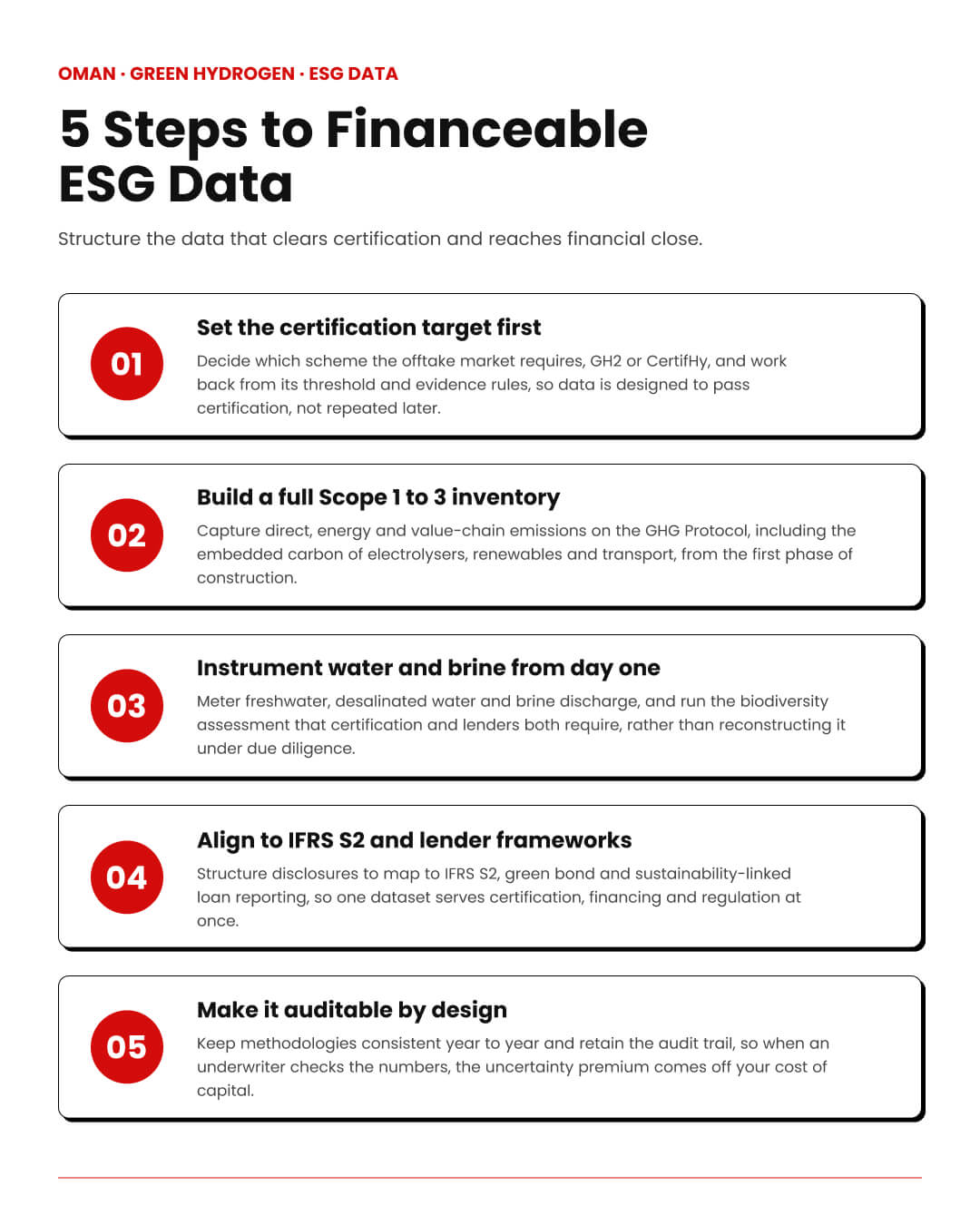
How to Structure Green-Hydrogen ESG Data in Five Steps
- Set the certification target first. Decide which scheme the offtake market requires, GH2 or CertifHy, and work back from its threshold and evidence requirements so data collection is designed to pass certification, not repeated later.
- Build a full Scope 1 to 3 inventory on the GHG Protocol. Capture direct, energy and value-chain emissions, including the embedded carbon of electrolysers, renewables and transport, from the first phase of construction.
- Instrument water and brine from day one. Meter freshwater, desalinated water and brine discharge, and run the biodiversity assessment certification and lenders both require, rather than reconstructing it under due diligence pressure.
- Align the data to IFRS S2 and lender frameworks. Structure disclosures so they map to IFRS S2, green bond and sustainability-linked loan reporting, so one dataset serves certification, financing and regulation.
- Make it auditable by design. Keep methodologies consistent year to year and retain the audit trail, so that when an underwriter or assurance provider checks the numbers, the uncertainty premium comes off the cost of capital.
Frequently Asked Questions
Where Spectreco Fits
Oman's green hydrogen projects will be judged twice: once on engineering, and once on the data that proves they are genuinely low-carbon, water-responsible and financeable. The developers who treat ESG data as core project infrastructure, built from the first phase, are the ones who will clear certification and reach financial close without a late scramble.
Spectreco helps project developers and their lenders build that capability on one cloud-native ESG platform: a full Scope 1 to 3 emissions inventory, water and biodiversity tracking, certification-ready evidence, and IFRS S2 and sustainable-finance disclosures from a single dataset. The same approach already supports financial institutions across the region, as in our guide to climate risk and financed emissions for Omani banks.
To start, book a green-hydrogen ESG data and reporting assessment with our team through Spectreco's Climate Finance & Green Capital advisory.
.jpg)
.jpg)
More From Our Blog

.jpg)
Your ESG Journey?