

SBP Green Banking & Financed Emissions: Beyond IFRS S2

SBP Green Banking and Financed Emissions: What Pakistani Banks Must Do Beyond SECP IFRS S2
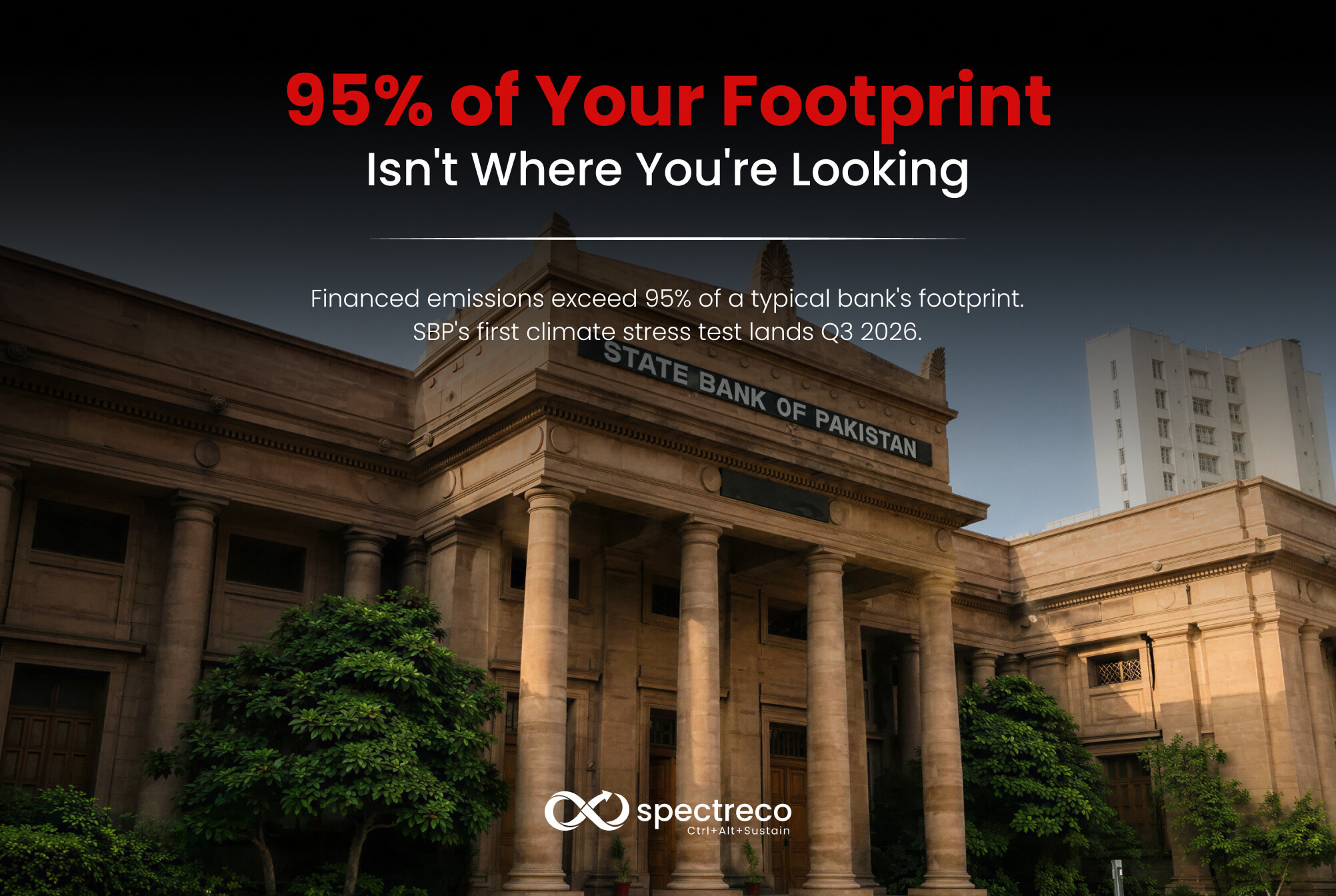
By the end of the third quarter of 2026, every bank, development finance institution, and microfinance bank regulated by the State Bank of Pakistan (SBP) must run its first climate stress test. That deadline is why SBP green banking and financed emissions have become a board-level issue for Pakistani banks in 2026, not a problem for later. Yet many Chief Risk Officers still treat the Securities and Exchange Commission of Pakistan (SECP) and its IFRS S2 climate disclosure standard as the entire climate agenda.
Source: State Bank of Pakistan, climate stress testing guidelines (December 2025), via Profit
It is not the entire agenda. SBP runs a separate, prudential regime that expects banks to manage climate risk, not simply report it. Spectreco, an ESG technology and advisory firm with offices in Atlanta, Lisbon, Dubai, Muscat, and Lahore, sees the same gap across the sector. A bank prepares an IFRS S2 disclosure for SECP, files it, and assumes the regulators are satisfied. The SBP supervisory expectations then sit unmet, and the same climate data is rebuilt twice.
This article maps what SBP actually requires, how it relates to SECP IFRS S2, and why financed emissions decide the size of the job. The short version: build the data once, satisfy both regulators.
On this page
- What do SBP green banking guidelines require?
- How do SBP rules relate to SECP IFRS S2?
- Do Pakistani banks have to measure financed emissions?
- One data programme that satisfies both regulators
- A five-step bank climate-data roadmap
- Frequently asked questions
What Do SBP Green Banking Guidelines Require?
SBP green banking guidelines require every bank and DFI to run a board-approved green banking policy, set up a green banking office, screen environmental and social risk inside credit decisions, keep an exclusion list, cut their own resource use, and report progress to SBP. Climate risk management, scenario analysis, and stress testing now sit on top.
The 2017 Green Banking Guidelines: the foundation
SBP issued its Green Banking Guidelines (GBG) in October 2017 through SMEFD Circular No. 8. They cover three areas: environmental risk management inside lending, facilitation of green business, and reduction of the bank's own footprint. Each bank must hold a board-approved green banking policy, designate a green banking office, fold environmental screening into credit assessment, maintain an avoidance list of prohibited activities, and report to SBP.
Source: SBP, Green Banking Guidelines, SMEFD Circular No. 8 of 2017
The 2022 ESRM manual: environmental and social risk
In November 2022, SBP launched the Environmental and Social Risk Management (ESRM) Implementation Manual with the International Finance Corporation. ESRM is the system banks use to find and manage environmental and social risks in lending and investment, from pollution and climate hazards to labour rights and community safety. Adoption was voluntary for an initial three years, through 2025, with SBP monitoring progress quarterly. That window has now closed, and supervisory expectations are hardening.
Source: The Express Tribune, three years given to opt for green banking (November 2022) • Resources Future, green banking and ESRM briefing
The 2025 climate risk framework and stress testing: now binding
This is where green banking stops being guidance. In 2025, SBP formally built climate into financial sector regulation through a Regulatory Framework for Effective Management of Climate-Related Financial Risks. It requires banks, DFIs, and microfinance banks to integrate climate into governance, strategy, and risk management. In December 2025, SBP followed with Guidelines on Climate Stress Testing.
Source: SBP Financial Stability Review 2025, reported via WealthPK (May 2026)
Under the stress testing guidelines, regulated institutions apply single-factor climate shocks for physical and transition risk. The first iteration may be run by the end of the third quarter of 2026, using data as of 31 December 2025. Domestic systemically important banks (D-SIBs) must also fold climate scenarios into their annual macro stress testing. SBP will run its own in-house tests and review bank frameworks.
Source: Profit by Pakistan Today, SBP introduces climate stress testing framework (December 2025)
The Pakistan Green Taxonomy: a common definition of green
The Pakistan Green Taxonomy, launched in 2025 by the Ministry of Climate Change with SBP and SECP, gives the market one science-based definition of which activities count as green. The 2025 version names priority sectors across climate change mitigation and adaptation. SBP has advised financial institutions to use it as a reference when developing or updating their green banking policies, which means banks should map their products and lending against it.
Source: Resources Future, Pakistan Green Taxonomy briefing
How Do SBP Rules Relate to SECP IFRS S2?
SBP and SECP do different jobs. SBP is a prudential regulator: it wants banks to manage climate risk inside credit and stress testing. SECP is a disclosure regulator: IFRS S2 sets out how listed companies report climate risk to investors. A Pakistani bank sits under both, so an IFRS S2 disclosure alone does not satisfy SBP.
SECP formally mandated IFRS S1 and IFRS S2 on 31 December 2024 for listed companies and SECP-licensed public interest companies, phased by total assets, turnover, and employee count. Phase 1 begins for annual reporting periods on or after 1 July 2025, with later phases following in 2026 and 2027. External assurance starts from the second year of reporting. Our SECP Phase 2 readiness guide sets out the size thresholds in full.
Source: SECP, notification of IFRS Sustainability Disclosure Standards (January 2025)
Here is the nuance most banks miss. SECP notifies accounting standards for companies under the Companies Act 2017, but SBP prescribes the accounting and reporting framework for banks. A listed bank is captured by IFRS S2 as a listed company, and large banks fall into the early phases by their asset size. In practice, though, SBP operationalises IFRS for the banking sector on its own circulars, as it did with IFRS 9 from January 2024.
Source: IFRS Foundation, jurisdiction profile: Pakistan • SBP Financial Stability Review 2024, The Banking Sector
So a bank answers to two masters at once. The table below is the cleanest way to hold both in view.
Read the two columns together and the lesson is plain. The prudential column needs richer, forward-looking risk data than the disclosure column, and both draw on the same underlying exposures. A bank that builds only for the right-hand column will fail the left.
Do Pakistani Banks Have to Measure Financed Emissions?
In practice, yes. Financed emissions are the greenhouse gases tied to a bank's loans and investments, classified as Scope 3 Category 15. For most financial institutions they exceed 95 percent of the total carbon footprint, according to PCAF. IFRS S2 requires Scope 3 disclosure where material, and SBP stress testing needs the same exposure data.
Most banks discover that their own buildings, travel, and electricity are a rounding error. The carbon that matters sits in the loan book. The Partnership for Carbon Accounting Financials (PCAF), the global standard for measuring emissions linked to loans and investments, puts financed emissions above 95 percent of a typical financial institution's footprint. That single fact reframes the whole exercise: for a bank, climate data work is portfolio data work.
Source: PCAF, Global GHG Accounting and Reporting Standard for the Financial Industry
PCAF released the third edition of its Financed Emissions standard (Part A) on 2 December 2025. It widens balance-sheet coverage from seven to ten asset classes, adding methods for use-of-proceeds structures, securitisations, sub-sovereign debt, and an optional treatment for undrawn loan commitments aligned with IFRS S1 and S2. It keeps the 1 to 5 data quality scoring scale, so banks can be honest about where estimates end and verified data begins.
Source: PCAF, launch of the updated GHG accounting standard (2 December 2025)
Why this matters for Pakistan: syndicated loans, project finance, and sukuk are real parts of local bank books, and the new asset classes finally give a defensible method for them. PCAF-based financed emissions accounting is the data layer that both regulators ultimately rely on. Banks in the wider region face the same logic, as our analysis of what banks in Qatar must report under IFRS S1 and S2 shows.
One Data Programme That Satisfies Both Regulators
The temptation is to treat SECP and SBP as two projects with two teams, two spreadsheets, and two timelines. That is how banks burn budget and still miss deadlines. The smarter move is to recognise that both regulators are asking questions about the same loan book.
IFRS S2 wants governance, strategy, risk management, and metrics, including material Scope 3 financed emissions. SBP wants climate risk embedded in credit and tested through single-factor shocks. Both need counterparty and sector exposures, both need physical and transition risk drivers, and both need financed emissions. Collect that once, govern it like financial data, and you feed every requirement from a single source.
This is exactly where a cloud-native ESG platform earns its place. Mapping exposures to PCAF asset classes by hand, in spreadsheets, will not survive assurance review or a supervisory inspection. Governed calculation rules, versioned methods, and an exclusions register turn a fragile manual process into an audit-ready one that answers to both SBP and SECP.
A Five-Step Bank Climate-Data Roadmap

Here is the sequence we use with bank clients to satisfy both regulators from one programme.
- Map both regulators into one requirements register. Pull SBP Green Banking, ESRM, the Green Taxonomy, the 2025 climate risk framework, and climate stress testing into the same register as SECP IFRS S2. Tag every obligation to an owner and a deadline.
- Build one climate data model, not two. Define the data once: exposures by counterparty and sector, financed emissions inputs, and physical and transition risk drivers. Govern it with the same rigour as financial data.
- Stand up financed emissions accounting on PCAF. Adopt the PCAF third edition, map exposures to its ten asset classes, and score data quality on the 1 to 5 scale. This single dataset feeds IFRS S2 Scope 3 and SBP stress testing.
- Run stress testing and risk integration together. Use the same exposures and emissions for SBP single-factor shocks and for IFRS S2 scenario analysis. Document assumptions so they survive supervisory review and external assurance.
- Disclose once, report many times. Produce one audit-ready dataset that supplies the SECP IFRS S2 disclosure, SBP supervisory returns, and investor and lender requests, with a clear exclusions register where data is incomplete.
Frequently Asked Questions (FAQs)
Where Spectreco Fits
Spectreco runs a bank climate-risk advisory built for exactly this dual-regulator reality in Pakistan. We help risk and sustainability teams stand up PCAF-based financed emissions, run SBP-aligned climate stress testing, and produce a SECP IFRS S2 disclosure from one governed dataset. The advisory is backed by our ESG platform and Virtual Sustainability Office, so the work does not collapse back into spreadsheets after the engagement ends.
Next step: book a bank climate-risk readiness assessment through Spectreco's Climate and Green Finance advisory. If your priority is the disclosure itself, start with Compliance, Reporting and Disclosures. We will map your obligations to both regulators and tell you, honestly, where your data stands before the Q3 2026 stress test lands.
.jpg)
.jpg)
More From Our Blog

.jpg)
Your ESG Journey?