

ESG Readiness vs ESG Reporting: What Companies Actually Gain Beyond IFRS S1/S2

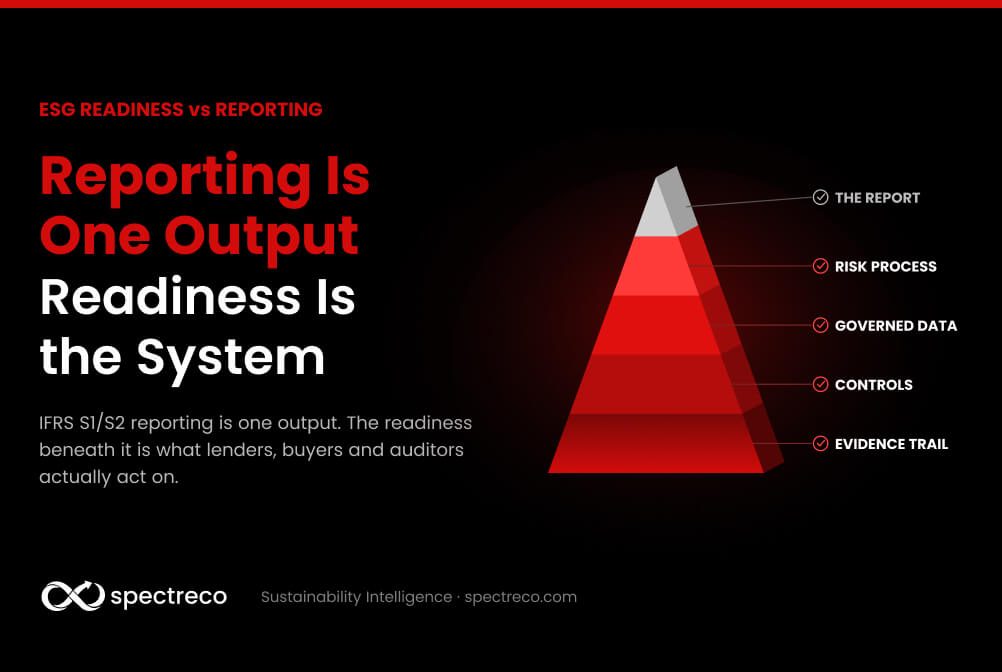
Most boards first meet ESG as a reporting deadline. In Pakistan that deadline comes from the Securities and Exchange Commission of Pakistan (SECP), which has phased in IFRS S1 and IFRS S2 from 1 July 2025. In the Gulf it comes from exchanges, central banks and the UAE Climate Law. The report gets the attention. The capability behind it is what lenders, buyers and investors actually act on.
That capability is ESG readiness, and the ESG readiness benefits beyond IFRS S1 and S2 reporting in 2026 are larger, and more specific, than the report itself. They show up as credit approvals, export orders kept, energy bills cut, losses planned for and deals that close on time.
Spectreco, a US-headquartered sustainability technology and advisory company with offices in Atlanta, Lahore, Lisbon, Dubai and Muscat, works with listed companies, banks and exporters across Pakistan and the GCC on both the report and the capability behind it. This pillar sets out what ESG readiness is, what it gets you, where the claims are overstated, and how to build it in five steps.
On this page
- What is ESG readiness?
- ESG readiness vs ESG reporting: why the report is one output
- What do companies gain from ESG readiness beyond compliance?
- Who gains what, by client type
- Where the benefits of ESG readiness are overstated
- How to build ESG readiness in five steps
- Frequently asked questions
What Is ESG Readiness?
Direct answer: ESG readiness is a company’s proven ability to produce sustainability information that investors, lenders and buyers can use and an assurer can check, on its regulator’s timeline. It is a capability, not a document. The IFRS S1/S2 report is one output of it.
No regulator publishes a formal definition of “ESG readiness”. Spectreco’s working definition is built from what the IFRS Foundation, the Committee of Sponsoring Organizations of the Treadway Commission (COSO) and the International Auditing and Assurance Standards Board (IAASB) actually require.
The four parts of ESG readiness
- A risk and opportunity process. A documented way of finding which sustainability issues affect cash flow, access to finance and cost of capital, which is what IFRS S1 asks a company to disclose.
- Governed data. Named owners, clear data lineage and the use of “all reasonable and supportable information that is available at the reporting date without undue cost or effort”, the IFRS Foundation’s own proportionality test.
- Internal controls. Controls over sustainability data built on the same COSO Internal Control-Integrated Framework that already governs financial reporting.
- An evidence trail an assurer will accept. ISSA 5000, the IAASB’s sustainability assurance standard, applies to periods beginning on or after 15 December 2026.
Sources: IFRS Foundation proportionality factsheet, Jan 2025, COSO ICSR guidance via The IIA, 30 Mar 2023, IAASB ISSA 5000 fact sheet
A company that has all four can answer a new question from a bank or a buyer from data it already holds. A company that has only the report has to start again every time someone asks.
ESG Readiness vs ESG Reporting: Why the Report Is One Output
ESG reporting is the annual disclosure a regulator requires. ESG readiness is the system that produces it, and that same system answers a dozen other parties who never read the annual report.
The Pakistan timeline makes the difference urgent
SECP’s adoption of IFRS S1 and S2 runs in three phases:
- Phase I: annual periods beginning on or after 1 July 2025, for listed companies meeting any two of turnover above Rs 25 billion, more than 1,000 employees or total assets above Rs 12.5 billion.
- Phase II: periods beginning on or after 1 July 2026.
- Phase III: periods beginning on or after 1 July 2027, covering all remaining listed companies and SECP-licensed public interest companies.
Assurance is required from the second year of reporting. A Phase I company that treated year one as a writing exercise now has to show an auditor where every number came from. Our complete SECP IFRS S2 compliance guide covers the disclosure detail.
Sources: IFRS Foundation Pakistan jurisdictional profile, SECP press release, 1 Jan 2025
One dataset, five asks
The same governed data, controls and board oversight that feed the IFRS report also answer:
- the bank’s environmental and social due diligence checklist
- the brand’s supplier audit
- the importer’s Carbon Border Adjustment Mechanism (CBAM) declaration
- the investor’s due diligence list
- the assurer’s sample requests
Built once, it is used five times. Built only for the report, it serves one.
What Do Companies Gain From ESG Readiness Beyond Compliance?
Direct answer: ESG readiness pays mainly through access, not discounts. It keeps a company eligible for lenders, buyers, investors and export markets that now screen on ESG data, and it surfaces operating savings and risks that were invisible before measurement. Direct price effects are real but small, usually single to low double-digit basis points.
Six outcome areas hold up against the evidence. Each is tied to a decision a third party already makes with your data.
1. Finance access: staying financeable, and paying a little less
The main finance benefit is eligibility. The State Bank of Pakistan (SBP) requires banks and development finance institutions to apply its Environmental and Social Risk Management (ESRM) Implementation Manual, run an E&S due diligence checklist on SME and corporate projects, and report on it to SBP every year. SBP has also advised banks to use the Pakistan Green Taxonomy as the reference guide for their green banking policies (SH&SFD Circular 06 of 2025, 10 December 2025).
Sources: SBP Circular Letter 12 of 2022, SBP SH&SFD Circular 06 of 2025
Development lenders go further. The International Finance Corporation (IFC) “will only finance investment activities that are expected to meet the requirements of the Performance Standards”, and the actions in its E&S action plan are conditions of the investment. The Asian Development Bank (ADB) applies 10 mandatory environmental and social standards to borrowers from 1 January 2026. See how this plays out locally in our posts on SBP green banking and Pakistan’s Green Taxonomy and the cost of capital.
Sources: IFC Sustainability Framework, paras 22 and 28, ADB Environmental and Social Framework
The price benefit exists but is modest, so it belongs second in any CFO conversation:
- Sustainability-linked loans: across 573 loans issued from 2017 to 2021, the average margin adjustment was about 4.8 basis points (Loumioti and Serafeim, Harvard Business School working paper, November 2022).
- Equity cost of capital: from 2015 to 2019, the top ESG quintile of MSCI World averaged a 6.16% cost of capital against 6.55% for the bottom quintile, a gap of about 39 basis points (MSCI, February 2020).
Sources: Loumioti and Serafeim, HBS Working Paper 23-027, Nov 2022, MSCI, ESG and the cost of capital, 25 Feb 2020
Our CFO guide to sustainable finance and cost of capital covers how to put those numbers in a financing plan.
2. Export access: keeping and winning EU orders
For exporters, readiness is a licence to keep selling. CBAM entered its definitive phase on 1 January 2026, with the first surrender of certificates due 30 September 2027. Where a producer cannot supply actual emissions data, the importer pays on default values that rise by 10% in 2026, 20% in 2027 and 30% from 2028 (fertiliser defaults rise 1% a year instead). Your data sets your buyer’s carbon bill.
Source: ICAP, EU CBAM enters compliance phase
Pakistan’s EU trade preferences are also back on the table. In 2024, Pakistan’s GSP+ eligible exports to the EU were worth EUR 7.5 billion, with 95.1% utilisation and about EUR 732 million in tariff savings. Under the new EU GSP regulation, which applies from 1 January 2027, Pakistan must reapply, the number of conventions rises from 27 to 32, and current benefits run through a transition ending in late 2028.
Sources: Profit, 17 Jul 2026, Arab News Pakistan
For sector detail, see our guides for Pakistani textile exporters on CBAM and GCC manufacturers on CBAM carbon data.
3. Operating savings: costs you could not see before
Measurement finds money. The International Energy Agency (IEA) reports that energy management in industrial companies delivers “more than 10% energy savings on average within the first three years of implementation”, with some firms reporting 30% or more, and many measures need little or no spending.
Source: IEA, Energy management for industry
Those savings depend on metered, owned data for energy, water and waste: the governed-data part of readiness. A mill that has never metered its boilers by line cannot find the leak. One that has can price each fix against payback before any ESG report is written.
4. Physical risk: losses you can see, plan for and price
A climate risk assessment turns floods, heat and water shortages from surprises into planned costs. Pakistan’s 2022 floods caused more than USD 14.9 billion in damage and about USD 15.2 billion in economic losses, according to the post-disaster needs assessment led by the World Bank.
Source: World Bank press release, 28 Oct 2022
Insurance will not carry most of it. In 2025, Asia-Pacific natural disasters caused about USD 73 billion in losses, of which only USD 9 billion was insured. For apparel exporters the exposure is direct: a Cornell University and Schroders study projects USD 65 billion (22%) in lost apparel export earnings across Pakistan, Bangladesh, Cambodia and Vietnam from 2025 to 2030, from extreme heat and flooding.
Sources: Munich Re, natural disaster figures 2025, Jan 2026, Dawn, on the Cornell GLI and Schroders study
5. Deals: a data room that is already full
When a company is bought, sold, listed or funded, ESG gaps now kill or reprice deals. In Deloitte’s 2024 Global ESG M&A Survey of 500 leaders, 72% said they had walked away from an acquisition over ESG concerns, up from 49% in 2022.
Source: Deloitte Global ESG M&A Survey, Jan 2024
A family group selling a stake to private equity, or a GCC company preparing to list, will face an ESG questionnaire. A company with governed data answers it from what it already holds, and keeps its negotiating position.
6. Compliance and assurance cost: cheaper the second time
The report will be required anyway. Readiness decides whether it is an annual scramble or a by-product of systems that already run. Assurance is now the norm for large companies: 73% of large G20 companies obtained assurance on sustainability disclosures in 2023, up from 69% the year before.
Source: IFAC and AICPA-CIMA, 12 May 2025
Investors are why. In PwC’s 2023 Global Investor Survey of 345 investors and analysts, 94% said sustainability reporting contains at least some unsupported claims, and 85% said reasonable assurance would give them at least moderate confidence. An assurer charges for every gap in lineage and controls, so the cheapest assurance is on data governed from the start. Our ISSA 5000 readiness guide sets out what assurers will test.
Source: PwC Global Investor Survey 2023
Who Gains What: ESG Readiness Value by Client Type
The lead benefit changes by client type. Start the conversation with the lead benefit, support it with the second, and keep the report itself last.
This table is Spectreco’s synthesis of the evidence in this article, not a sourced ranking.
GCC companies facing the federal greenhouse gas reporting duty can start with our post on the UAE Climate Law and GCC ESG compliance.
Where the Benefits of ESG Readiness Are Overstated
A skeptical CFO will push back on the usual ESG claims, and on several points the CFO is right. Credibility depends on saying so.
ESG ratings disagree with each other
ESG ratings from different providers correlate at only 38% to 71% on average, so a “good ESG score” depends heavily on who is scoring. MSCI also found that rating upgrades were linked to a lower cost of capital in developed markets, but the effect was not present in emerging markets.
Sources: Berg, Kölbel and Rigobon, “Aggregate Confusion”, Review of Finance, Nov 2022, MSCI, 25 Feb 2020
The green bond premium has largely gone
The Federal Reserve found green corporate bonds priced about 8 basis points below comparable bonds, with the premium appearing from 2019 and driven by investor demand. Later work from the Copenhagen Business School Nordic ESG Lab (July 2025) finds the discount fell to a statistically negligible level by 2020 and had turned slightly positive by 2024. Do not pitch a green label as cheap money.
Sources: Federal Reserve IFDP, The green corporate bond issuance premium, CBS Nordic ESG Lab, 18 Jul 2025
Disclosure alone does not drive performance
The NYU Stern Center for Sustainable Business review of more than 1,000 studies (2015 to 2020) found 58% of corporate studies positive, 13% neutral, 21% mixed and 8% negative. Its own conclusion: “ESG disclosure on its own does not drive financial performance.” The study was produced with Rockefeller Asset Management, an ESG investor.
Source: Whelan et al., NYU Stern and Rockefeller Asset Management, 2021
Mandates can shrink, and surveys flatter
The EU’s Omnibus I directive, in force since 18 March 2026, limits the Corporate Sustainability Reporting Directive (CSRD) to companies with more than 1,000 employees and over EUR 450 million in turnover. Deal surveys also run ahead of practice: in Bain’s 2022 survey of 281 M&A executives, only 11% regularly and thoroughly evaluated ESG in deals. Our CSRD Omnibus timeline covers the EU detail.
Sources: DLA Piper on Directive (EU) 2026/470, Bain, ESG imperative in M&A, 2022
What survives the skepticism
The benefits that hold up are the ones tied to a third party’s decision: a bank’s credit screen, a buyer’s supplier rules, the EU’s CBAM calculation, an investor’s due diligence and an assurer’s opinion. Spectreco’s view is simple. ESG readiness is worth as much as the decisions other people make with your data, and in Pakistan and the GCC the number of those decisions is growing even as the EU narrows its rules.
We dropped claims the evidence does not support for our markets: better brand reputation, easier hiring and generic “ESG leaders outperform” lines.

How to Build ESG Readiness in Five Steps
Readiness is built in the same order an assurer will test it. Each step produces something a lender, buyer or auditor can use on its own.
- Map the third-party asks. List every party that already wants your ESG data: SECP or your exchange, your banks, your EU buyers, your investors. Rank them by the deadline and the money at stake.
- Assess material risks and opportunities. Run an IFRS S1-style assessment of which issues affect cash flow, financing and cost of capital, including physical climate risk at each major site.
- Govern the data. Give each metric a named owner, a source system and a documented calculation, using reasonable and supportable information you hold at the reporting date.
- Put controls around it. Apply the COSO internal control principles your finance team already uses to sustainability data, with review, sign-off and change logs.
- Test the evidence trail before the assurer does. Run a dry-run sample against ISSA 5000 expectations, fix the gaps, then produce the report and reuse the same dataset for every ask on your list.
Spectreco’s AI cloud-native ESG platform holds the governed dataset for steps three to five, and our Capacity Building and Training advisory trains the client team that will own it.
Frequently Asked Questions
Where Spectreco Fits
Spectreco helps companies build the capability, not just write the report. Our advisory team works alongside your finance, risk and sustainability teams to map the third-party asks, set up governed data and controls, and test the evidence trail before assurance.
The Virtual Sustainability Office combines that advisory team with our ESG platform, so the same dataset keeps serving your regulator, banks, buyers and investors after the first report.
Next step: book a Spectreco ESG readiness assessment through our Compliance, Reporting and Disclosures advisory and see which of the four readiness parts your company already has, and which will cost you at the next bank review, buyer audit or assurance engagement.


More From Our Blog

Your ESG Journey?