

How AI Is Transforming ESG Reporting: 2026 Guide


How AI Is Transforming ESG Reporting: A Complete Guide for 2026
ESG reporting has broken under its own weight. Sustainability teams at mid-market and large enterprises are now managing dozens of disclosure frameworks simultaneously: AASB S2 in Australia, the Corporate Sustainability Reporting Directive (CSRD) in Europe, IFRS S2 as mandated by Pakistan's Securities and Exchange Commission of Pakistan (SECP), and the Gulf Cooperation Council's emerging multi-regulator requirements. The data they need lives inside ERP systems, building sensors, supplier portals, and finance teams spread across multiple countries.
Manual spreadsheet workflows cannot hold this together. A 2024 study cited by Footprint Intelligence found that 70% of sustainability leaders believe time and cost spent on manual reporting has contributed to delays in decarbonisation. KPMG data shows 47% of organisations still rely on spreadsheets for ESG data aggregation, even as regulatory deadlines close in.
AI ESG reporting software automation in 2026 is not theoretical. It is what separates teams that file on time, with auditor-grade accuracy, from those that spend six months chasing supplier invoices and correcting formula errors. Spectreco, an ESG technology and advisory firm with offices in Atlanta, Lahore, Lisbon, Dubai, and Muscat, has built its cloud-native AI platform around five specific use cases that address the most time-intensive failure points in corporate ESG reporting.
This guide covers how those five use cases work, what they mean for Scope 3 data collection, how multi-framework reporting across AASB S2, CSRD, and SECP IFRS S2 becomes feasible simultaneously, and what questions to ask any platform vendor before signing a contract.
Verdantix ESG Reporting Software Market Forecast 2023-2029 | Footprint Intelligence, 2026 | KPMG ESG Reporting Survey, 2024
Why Manual ESG Reporting Is Failing
The collapse of manual ESG processes is not anecdotal. It follows a predictable pattern: regulatory scope expands, data volume increases, and spreadsheet-based workflows expose their structural limits at the worst possible moment, during assurance reviews.
- Volume: The CSRD requires companies to report against the European Sustainability Reporting Standards (ESRS). Scope 3 emissions alone span 15 categories under the GHG Protocol, meaning a manufacturer with 200 suppliers must gather structured data from 200 different reporting formats, as Artificio detail in their CSRD automation analysis.
- Accuracy: Manual Scope 1, 2, and 3 calculations rely on outdated emissions factors, inconsistent units, and formula-based spreadsheets that cannot self-correct. Atlas Metrics quantify the cost: companies failing to comply with the CSRD face financial penalties set by each EU Member State.
- Market pressure: Verdantix projects the global ESG reporting software market will grow from USD 1.3 billion in 2023 to over USD 5.6 billion by 2029, at a 26% compound annual growth rate. That growth is driven by necessity: companies cannot meet CSRD, AASB S2, and SECP timelines with the reporting infrastructure built for voluntary GRI disclosures five years ago.
Director penalties under AASB S2 (Australian Sustainability Reporting Standard S2: Climate-related Disclosures) can include civil penalties under the Corporations Act 2001, which ASIC enforces. This is no longer a sustainability team problem. It is a board-level financial risk.
The same assurance reviewer who signs off your financial statements will also sign off your AASB S2 sustainability report. Auditors are already flagging data lineage gaps and missing source documentation in companies that assumed their spreadsheet workflows were adequate.
Verdantix, ESG Reporting Software Forecast | Atlas Metrics, Hidden Costs of Manual ESG Reporting | Artificio.ai, ESG Reporting Automation (2026)
5 AI Use Cases Reshaping ESG Reporting in 2026
Each use case below addresses a distinct bottleneck in the reporting lifecycle. The most effective AI ESG platforms integrate all five into a connected data pipeline where the output of each stage feeds cleanly into the next.
1. Automated Data Extraction Across Systems and Documents
Most enterprise ESG data does not sit in one place. It lives in ERP systems, building management systems, utility bills, HR platforms, and supplier-submitted PDF reports. Extracting it manually means assigning staff to a task that is repetitive, error-prone, and impossible to scale as reporting scope expands.
AI-driven data extraction uses Optical Character Recognition (OCR) and Natural Language Processing (NLP) to read documents in any format, identify relevant data fields, and route them into a structured ESG data model automatically. A supplier's PDF emissions report, a scanned energy invoice, or an unformatted CSV from a third-party logistics provider all become usable inputs without manual re-entry: the AI reads the document, classifies the data type, and stores it with a documented lineage trail.
Spectreco's AI platform connects to ERP systems, building management infrastructure, HR platforms, finance and risk tools, IoT meters, and third-party data feeds through ETL pipelines and APIs, creating automated and auditable ESG data flows. Every input carries a documented lineage: source system, extraction date, and transformation applied. That lineage is exactly what assurance reviewers require under AASB S2 Group 2 and CSRD's data governance expectations.
Artificio.ai, ESG Reporting Automation (2026) | Passionfruit, AI ESG Compliance Automation
2. NLP for Supplier Questionnaire Processing
Scope 3 Category 1 (purchased goods and services) and Category 11 (use of sold products) are among the most data-intensive disclosures required under the GHG Protocol. Both depend on supplier data that arrives in inconsistent formats: some suppliers complete structured portals, others send narrative sustainability reports, others send nothing at all.
NLP models address this by reading supplier questionnaires and sustainability reports in natural language. They identify relevant data points, map them to standard fields in the company's reporting schema, flag gaps or implausible values, and pre-fill responses for human review. C3 AI's ESG platform documents this approach directly: NLP-based fuzzy matching selects the appropriate emissions factor even when source data is ambiguous or inconsistently labelled, cutting the manual classification step out of the workflow entirely.
This matters most for Scope 3 data collection timelines. AI platforms with supplier-facing questionnaire modules can shorten Scope 3 data collection cycles from months of manual work to weeks, according to vendor reports, by automating intake, classification, and gap-detection simultaneously.
For Pakistani banks navigating their first SECP IFRS S2 reporting cycle, Scope 3 supplier data is particularly scarce. Financed emissions disclosures for Pakistani financial institutions depend on the same NLP-assisted data intake approach, because counterparty emissions data across loan books is rarely structured or standardised.
C3 AI ESG Platform | City Science, Can AI Do My Carbon Accounting? | Spectreco, Financed Emissions for Pakistani Banks
3. Machine Learning for Emissions Factor Matching
Every activity in a carbon inventory requires matching to an emissions factor: a coefficient that converts an activity (litres of diesel, tonnes of steel, kilowatt-hours of electricity) into kilograms of CO2 equivalent. The GHG Protocol databases contain thousands of factors. Selecting the correct one requires understanding activity type, geography, unit of measure, and sector context.
Manual emissions factor matching is where carbon accounting errors concentrate. An analyst who selects the wrong geographic grid factor for purchased electricity, or who applies a spend-based emissions factor to data that warrants a supplier-specific factor, creates a systematic error that flows through every downstream calculation.
Persefoni describe how AI reads natural-language descriptions of activities and pairs them with the most accurate emissions factor, even when source data is ambiguous or inconsistently labelled. Machine learning models train on large emissions factor databases alongside historical matching decisions, then assign a confidence score and document the reasoning behind each match.
Continuous learning is the critical feature. Climatiq's approach, documented by Omdena, uses machine learning to flag anomalies and improve factor matching over time, providing full audit trails listing matched factors, calculation confidence, and metadata. Platforms that improve their factor matching accuracy based on reviewer corrections and updated database entries outperform static rule-based systems significantly.
For Australian companies preparing their first AASB S2 Scope 1 and Scope 2 submissions, accurate factor selection is foundational. The data collection process for AASB S2 Scope 1 and 2 requires matching each emission source to the correct National Greenhouse and Energy Reporting (NGER) factor, a task that AI handles in seconds and that manual analysts spend days on.
Persefoni, AI in Carbon Accounting | Omdena, Top AI Carbon Management SMEs (2026) | City Science, Can AI Do My Carbon Accounting?
4. Automated XBRL Tagging for Regulatory Filings
XBRL (eXtensible Business Reporting Language) is the machine-readable format required for regulatory filings under CSRD and expected under several emerging ISSB-aligned frameworks. Each disclosure datapoint must be tagged with the correct element from the relevant taxonomy: ESRS for CSRD, or the ISSB taxonomy for IFRS S2 filings.
Manual XBRL tagging is prohibitively slow. A CSRD-scope company reporting against the revised ESRS datapoint library faces hundreds of tagging decisions per filing cycle. Lucanet's XBRL Tagger Agent is described by Lucanet as reducing this from days of manual work to hours by embedding AI suggestions into the reviewer's workflow. The AI suggests the correct taxonomy element with a confidence score; the human reviewer approves or overrides each suggestion before the filing is committed.
XBRL International is clear that AI does not replace the tagging process: it accelerates and supports it. Digital tagging provides clarity, comparability, and traceability that investors and regulators depend on, and AI improves the efficiency of the tagging workflow without removing the human verification step required for investment-grade output. The pattern is consistent: AI handles the volume; human sign-off handles the accuracy guarantee.
For the post-Omnibus CSRD scope, where the revised rules apply to financial years starting in January 2027, getting ahead of XBRL tagging requirements now is what separates companies that file cleanly from those scrambling in Q4 2026.
XBRL International, AI and Digital Tagging in Sustainability Reporting | XBRL International, Digital Reporting and CSRD | Lucanet XBRL Tagger Agent
5. AI-Assisted Scenario Analysis
AASB S2, CSRD, and IFRS S2 all require climate scenario analysis: an assessment of how the company's strategy, assets, and financial position hold up under different warming trajectories and physical risk scenarios. Manual scenario analysis is a consulting-heavy, multi-week exercise.
AI-assisted scenario analysis changes the resource equation. By connecting the company's asset data, revenue exposure, and operational footprint to physical risk models and transition pathway databases, AI platforms can model multiple scenarios simultaneously, update them as assumptions change, and generate the disclosure narratives required by each framework.
AASB S2 requires analysis using at least a 1.5 degrees Celsius scenario and a scenario of 2.5 degrees or higher. For Australian real estate companies, climate scenario outputs also feed directly into GRESB assessments, which institutional investors use for capital allocation decisions. Running scenario analysis manually for both AASB S2 and GRESB on a single team is not feasible without automation.
Spectreco's compliance and reporting advisory includes scenario analysis support for AASB S2, IFRS S2, and CSRD simultaneously. The platform's portfolio analytics module connects asset-level physical risk data to financial exposure modelling, generating the scenario disclosure narratives that each framework requires from a single analytical run.
Spectreco, AASB S2 Complete Guide | Spectreco, GRESB and AASB S2 | Spectreco, Compliance & Reporting Advisory
How AI Cuts Scope 3 Data Collection Time
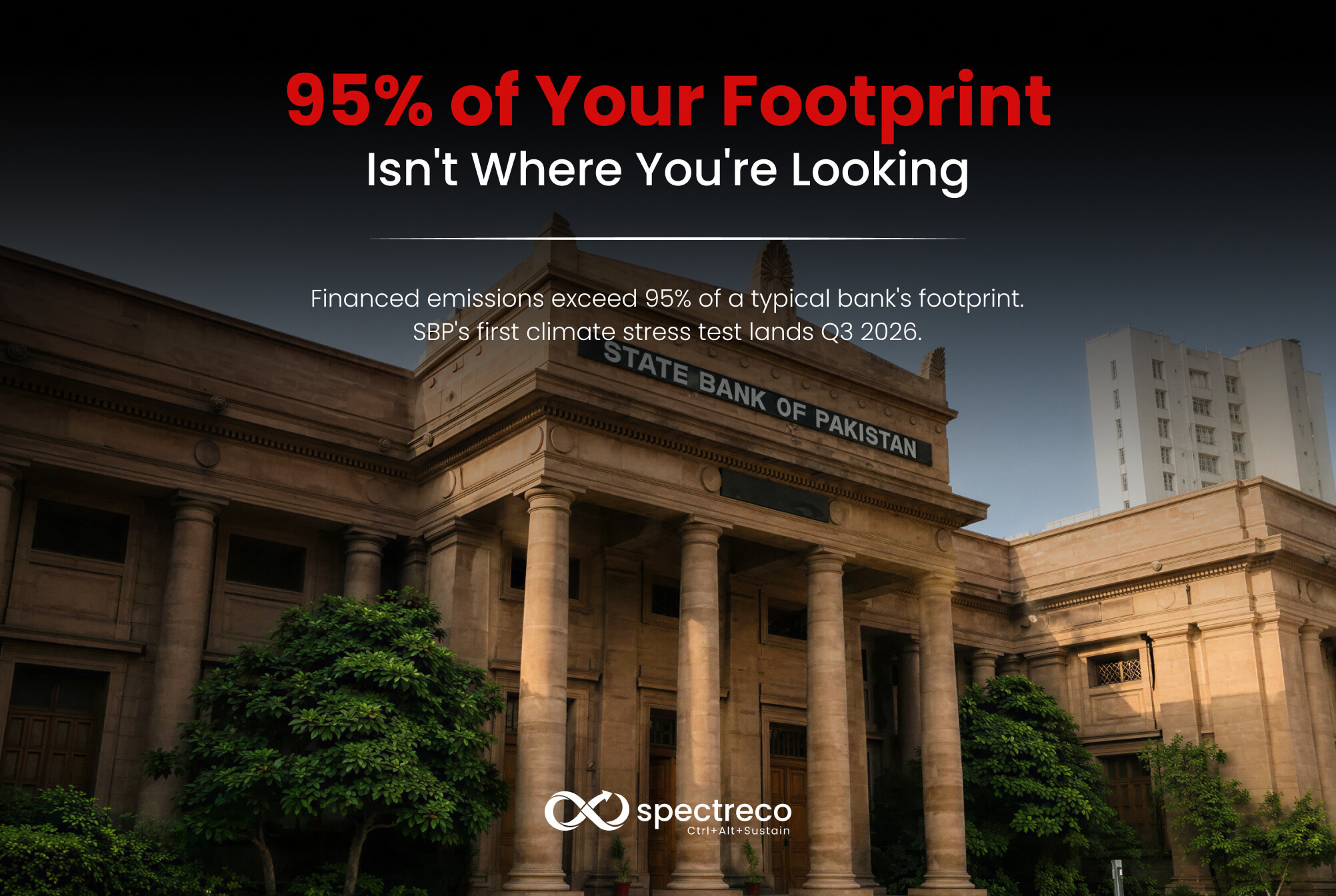
Scope 3 emissions, covering all indirect emissions across the value chain, represent the single largest reporting challenge for most companies. For financial institutions, the PCAF (Partnership for Carbon Accounting Financials) methodology is built on the point that financed emissions typically make up the large majority of a bank's total carbon footprint. Accurate Scope 3 measurement is the most material disclosure a financial institution will make, and the one most likely to fail under manual workflows.
Spectreco's financed emissions accounting capability supports financial institutions in measuring GHG emissions linked to lending, investment, and insurance portfolios across PCAF asset classes, with documented data quality scores that meet assurance requirements. For banks beginning their SECP IFRS S2 compliance journey, this financed emissions foundation is where the data pipeline must start.
Where AI Intervenes in the Scope 3 Workflow
The traditional Scope 3 data collection process involves five manual steps, each introducing delay and error risk:
- Identify applicable categories under the GHG Protocol
- Request data from suppliers, customers, and internal teams
- Collect and standardise responses in varying formats
- Select and apply emissions factors for each activity
- Validate totals and resolve gaps before filing
AI intervenes at steps two through five simultaneously. Supplier questionnaires are pre-filled based on prior-year data and NLP extraction from supplier sustainability reports. Incoming responses are standardised automatically. Emissions factors are matched by the ML layer. Anomalies and gaps are flagged before the human reviewer sees the dataset, rather than during audit.
This compression matters because companies subject to both AASB S2 and CSRD face different filing timelines. AASB S2 Group 2 reporting covers financial years beginning on or after 1 July 2026, with first reports due approximately October 2027. Under the revised CSRD (Directive (EU) 2026/470), most companies now start reporting for financial years beginning on or after 1 January 2027, with reports published in 2028. Only companies already reporting under the earlier rules (wave one) still report for 2025, and some may be exempted by their Member State. Running both processes on a manual timeline is not feasible for a single sustainability team.
For property companies with Australian portfolios, Scope 1 and 2 data collection is the prerequisite for everything that follows. The data collection workflow for AASB S2 compliance covers the source-by-source approach for building energy, fleet, and refrigerant data that feeds the AI platform's automated calculation layer.
PCAF, Partnership for Carbon Accounting Financials | Spectreco, Finance Emissions Accounting | AASB, AASB S2 Timelines
Multi-Framework Reporting: AASB S2, CSRD, and SECP IFRS S2 Simultaneously
The defining regulatory pressure of 2026 is not one framework. It is three or four, running on different timelines, with different materiality definitions, different assurance requirements, and different filing formats. Companies with global operations need to satisfy all of them from the same underlying dataset.
- AASB S2 (Australia): Mandatory for Group 1 companies from 1 January 2025, and for Group 2 companies from 1 July 2026. Uses financial materiality only. Requires climate scenario analysis, including a 1.5 degrees Celsius scenario and a higher-emissions scenario. The full scope and timeline covers who is caught, what must be disclosed, and what the assurance framework looks like.
- CSRD (European Union): Post-2025 Omnibus revision applies to companies with 1,000-plus employees and turnover exceeding EUR 450 million. Uses double materiality, requiring financial materiality plus impact materiality assessment. Reports must be filed in iXBRL format against ESRS datapoints. The revised rules apply to financial years starting in January 2027, but preparation cannot wait.
- SECP IFRS S2 (Pakistan): The Securities and Exchange Commission of Pakistan issued an order on 31 December 2024 mandating IFRS S1 and S2 for listed companies in phases, with Phase 1 from 1 July 2025. The complete SECP IFRS S2 compliance guide covers the data infrastructure, governance disclosure requirements, and timeline that Pakistani listed companies must now satisfy.
- GCC (Gulf Cooperation Council): Qatar's QCB and QFCRA mandate IFRS S1 and S2 for banks and regulated financial institutions from January 2026. The UAE Climate Law requires GHG inventory reporting under MOCCAE's MRV methodology. The UAE and GCC compliance obligations are distinct from IFRS S2: a company that is IFRS S2 compliant in Qatar is not automatically UAE Climate Law compliant. Sustainable bond issuance in the Middle East grew approximately 3% in 2025 even as global volumes fell 21%, according to S&P Global, making credible ESG disclosure a capital markets imperative across the region.
A spreadsheet workflow cannot produce compliant outputs for all four simultaneously. Each framework uses different materiality logic, different data fields, different filing formats, and different assurance standards. An AI platform that maps data once and generates framework-specific outputs removes the duplication entirely.
Spectreco, AASB S2 Complete Guide | Spectreco, EU Omnibus CSRD Analysis | Spectreco, UAE/GCC ESG Compliance Guide | Spectreco, SECP IFRS S2 Guide
The Write-Once, Report-Many Architecture
The correct mental model for multi-framework reporting is a single data architecture that outputs to multiple formats on demand. The underlying dataset is one: activity data, emissions factors, financial exposure, governance disclosures. The framework templates are the variables.
Spectreco's AI platform is built on this principle. Users configure a single ESG data model and generate regulator-ready, investor-ready, and board-ready reports across ISSB S1 and S2, CSRD/ESRS, GRI, TCFD, CDP, GHG Protocol, SBTi, and the Paris Agreement in a few clicks. The CSRD version uses ESRS datapoints and ESRS taxonomy tags. The AASB S2 version uses IFRS S2 structure and Australian scenario analysis inputs. The SECP version uses the same ISSB structure with Pakistan-specific regulatory context.
For ASX-listed companies with European operations, or Pakistani conglomerates with Australian investments, this is the only configuration that makes concurrent compliance feasible without doubling the reporting team. The Australian real estate sector faces exactly this dual-framework pressure: AASB S2 for domestic assets and CSRD for European investor reporting, with GRESB running across both.
Spectreco Platform: What the AI Actually Does
Spectreco has built its platform around three core architectural choices that distinguish it from general-purpose ESG software: AI agents embedded in the data pipeline, purpose-built workflows for the built environment and financial services, and regulatory depth across GCC, EU, Australian, and Pakistani frameworks that no single-market platform can match.
The following are verified platform capabilities, sourced from live platform documentation:
AI Agents for Data Cleaning and Validation
AI agents in the Spectreco platform run continuously against incoming data, performing four specific functions: cleaning and mapping data from connected sources; flagging anomalies that fall outside expected ranges for the asset type, sector, or geography; suggesting missing fields based on the regulatory profile; and recommending next actions based on the compliance timeline.
Controls and validations powered by rules and AI checks reduce errors and greenwashing risk. Role-based access controls determine who can view, edit, approve, and publish information, creating an audit trail that satisfies the assurance requirements of AASB S2 Group 2 reporting and CSRD data governance expectations. This is the same data governance architecture that financial regulators apply to financial reporting, now applied to ESG data.
Multi-Framework Report Builder
Spectreco's compliance advisory team pairs with the platform's report builder to design ESG reporting architectures and produce consistent, audit-ready disclosures across jurisdictions. Users map data once and generate outputs across all required frameworks, reducing manual duplication and error risk.
For financial institutions, the platform connects ESG metrics with financial exposures, supporting financed emissions calculations across PCAF asset classes and investment emissions reporting that satisfies TCFD, ISSB S2, and CSRD disclosure requirements concurrently. The financed emissions capability sits alongside built environment depth and GCC market presence in one platform.
Built Environment and Real Estate Depth
Spectreco's platform is trusted by real estate organisations, asset managers, commercial insurers, and municipalities. For real estate portfolios, this means property-level emissions tracking, GRESB (Global Real Estate Sustainability Benchmark) data integration, and EPC (Energy Performance Certificate) alignment within a single reporting environment.
GRESB is the annual ESG assessment scoring real estate portfolios and infrastructure funds, used by institutional investors for capital allocation decisions. For Australian property companies, a strong GRESB score is increasingly the mechanism through which AASB S2 physical risk disclosures translate into investor-visible performance metrics. The platform handles both within the same data model.
The platform's net zero and decarbonisation planning tools sit alongside reporting functionality, enabling organisations to move from disclosure to action: building transition plans, prioritising interventions, and linking emissions reductions directly to risk, cost, and value outcomes.
Buyer Checklist: 6 Questions to Ask Any AI ESG Software Vendor
"AI-powered" appears in the marketing of platforms that use basic rule-based automation with no machine learning. The questions below cut through that. Bring them to every shortlisted vendor before signing a contract.
| Platform Area | What It Does | Why It Matters |
|---|---|---|
| Write-Once, Report-Many Architecture | Creates one ESG data model covering activity data, emissions factors, financial exposure, and governance disclosures. | Allows companies to generate multiple reports across ISSB S1/S2, CSRD/ESRS, GRI, TCFD, CDP, GHG Protocol, SBTi, and Paris Agreement requirements without duplicating work. |
| Multi-Framework Reporting | Uses the same dataset to produce framework-specific outputs such as ESRS datapoints for CSRD, IFRS S2 structure for AASB S2, and SECP-specific ISSB reporting. | Supports companies operating across multiple jurisdictions, including ASX-listed companies with EU exposure and Pakistani groups with Australian investments. |
| AI Agents for Data Cleaning and Validation | Cleans and maps incoming data, flags anomalies, identifies missing fields, and recommends next actions based on compliance timelines. | Reduces errors, improves audit readiness, and lowers greenwashing risk through stronger data controls and validation checks. |
| Audit Trail and Access Controls | Role-based permissions determine who can view, edit, approve, and publish sustainability information. | Creates an assurance-ready audit trail for AASB S2, CSRD, and other regulatory disclosure requirements. |
| Financial Institution Reporting | Connects ESG metrics with financial exposure and supports financed emissions calculations across PCAF asset classes. | Helps banks, investors, and insurers report under TCFD, ISSB S2, CSRD, and PCAF requirements from one system. |
| Built Environment and Real Estate Depth | Supports property-level emissions tracking, GRESB data integration, EPC alignment, and real estate portfolio reporting. | Helps real estate companies connect investor-facing benchmarks with regulatory disclosures and decarbonisation planning. |
| Net Zero and Decarbonisation Planning | Links reporting data with transition planning, intervention prioritisation, and emissions reduction pathways. | Moves companies from compliance reporting to action by connecting emissions reductions with risk, cost, and value outcomes. |
Frequently Asked Questions (FAQs)
Next Step: See the Platform in Action
If your organisation is preparing for AASB S2 Group 2 compliance, working through a CSRD reporting architecture, or building Scope 3 measurement capability for SECP or GCC regulatory requirements, the gap between where you are now and where your auditor needs you to be is a platform and a methodology, not a headcount.
Spectreco's AI platform connects your data, automates your reporting workflows, and produces the audit-ready multi-framework disclosures that regulators, investors, and boards are now demanding. The platform is live and in production across real estate portfolios, financial institutions, and municipal governments on three continents.
Request a platform demonstration: spectreco.com/contact-us

.jpg)
.jpg)
More From Our Blog

.jpg)
Your ESG Journey?